Losing a tooth is more common than most people in Nairobi realise, and replacing it is one of the most frequent reasons patients come through our doors. Once you decide to fill the gap, two options dominate the conversation: a dental implant or a bridge. Both restore your smile and your bite, yet they work in completely different ways, and the better choice depends on your mouth, your priorities and your budget.
This guide compares dental implants vs bridges in plain terms. It covers how each one works, what it does to the teeth around the gap, how long each tends to last, and how to weigh the cost. By the end you should know which route fits your situation, and what to ask at your consultation.
Why Replacing a Missing Tooth Matters
It is tempting to leave a gap alone, especially if it does not show when you smile. That decision carries hidden costs.
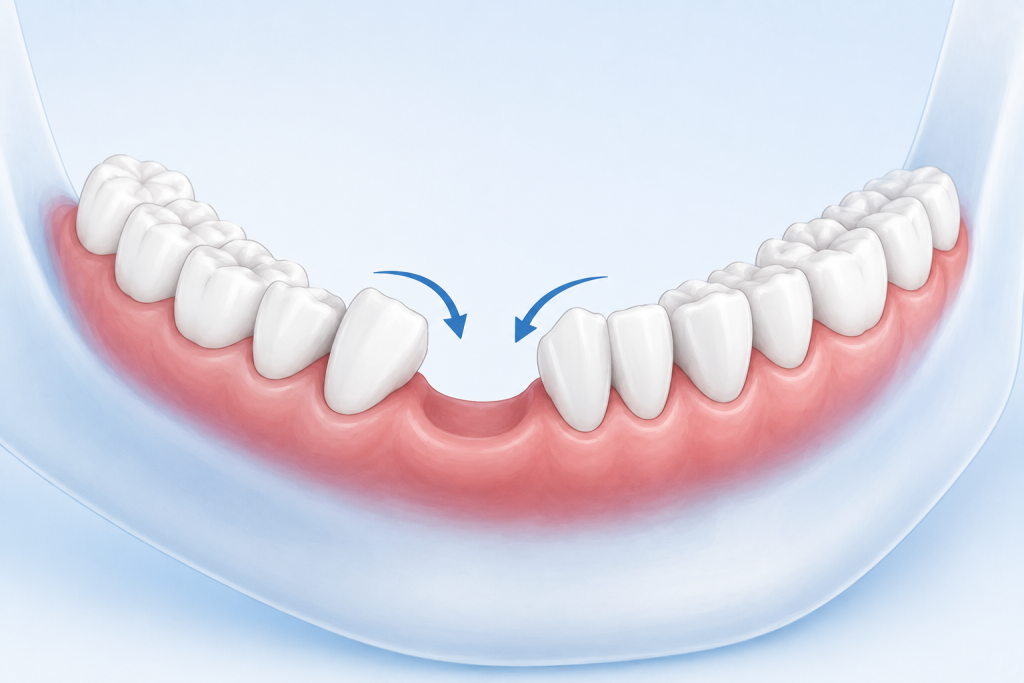
When a tooth goes missing, the neighbouring teeth slowly drift into the space and the opposing tooth can drift down to meet the gap. Your bite shifts, cleaning becomes harder, and a once-simple problem can grow into several.
There is a deeper issue too. The jawbone that once held the tooth root begins to shrink once the root is gone. Research on the healing of empty sockets shows measurable loss of ridge width and height in the months after an extraction, with the width of the ridge typically reducing by a few millimetres.¹ This matters cosmetically, because a sunken ridge ages the smile, and practically, because it can limit your options later.
So the real question is rarely whether to replace a missing tooth, but how. That brings us to the two main contenders.
What Is a Dental Bridge?
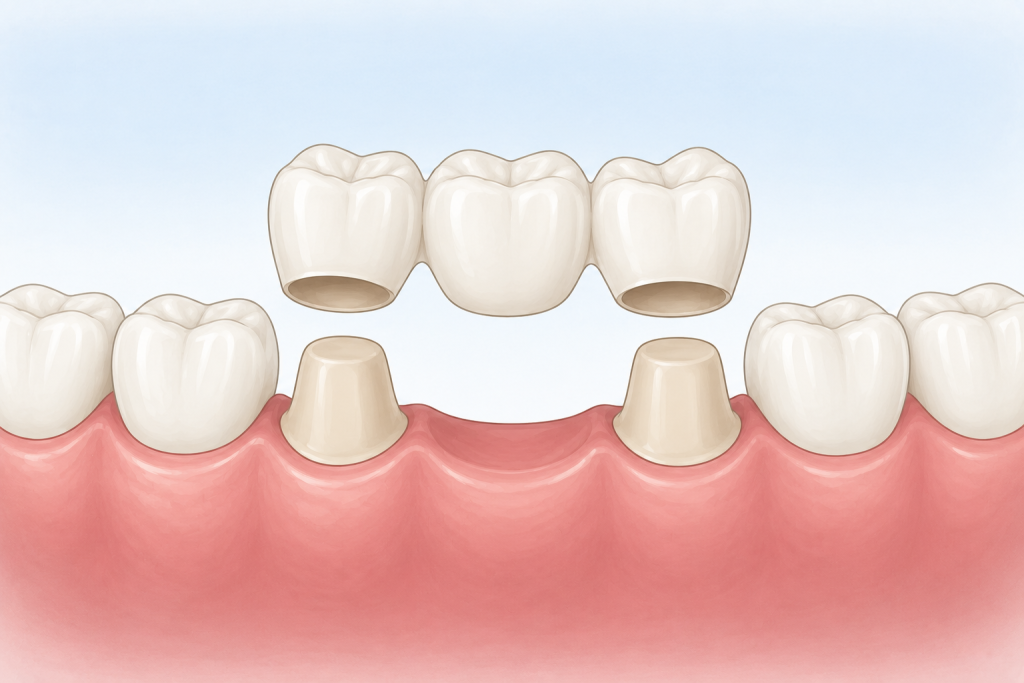
A dental bridge does exactly what the name suggests. It bridges the gap by anchoring a false tooth, called a pontic, to the natural teeth on either side. Those neighbouring teeth are crowned, and the crowns plus the false tooth are fixed together as one piece, then cemented into place.
A traditional bridge is fixed, comfortable and usually completed in two or three visits over a few weeks. It does not involve surgery, which appeals to many patients.
The main trade-off is what it asks of the neighbouring teeth. To carry the crowns, those healthy abutment teeth must be filed down, removing sound enamel. In a survey of practising dentists, this reduction of healthy teeth was identified as the major shortcoming of the fixed bridge compared with an implant.² Once enamel is removed it does not grow back, so those teeth are committed to supporting the bridge for the long term.
There is a more conservative type worth knowing about. A resin-bonded bridge, sometimes called a Maryland bridge, uses a thin wing bonded to the back of one neighbouring tooth instead of full crowns. It needs little or no drilling, which makes it attractive for younger patients or where cost and tooth preservation matter most.³ The compromise is that bonded bridges are generally better suited to front teeth under lighter bite loads, and the bond can debond over time.
What Is a Dental Implant?
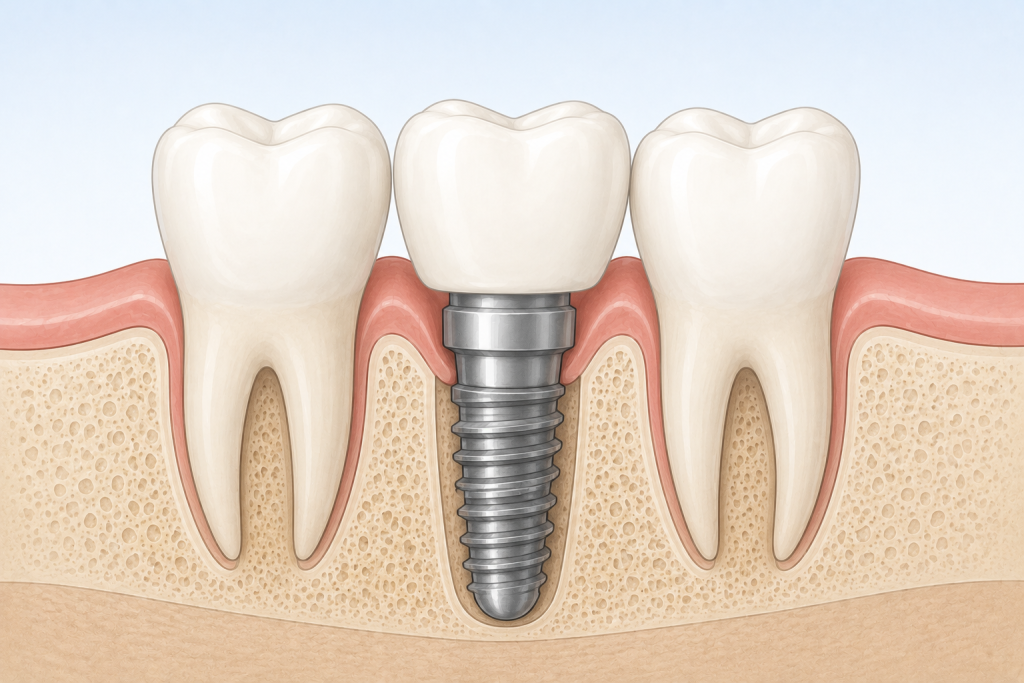
A dental implant replaces the missing tooth from the root upwards. A small titanium post is placed into the jawbone in a minor surgical procedure. Over a few months the bone fuses to the post, a process called osseointegration, creating a stable anchor. A crown is then fixed on top, giving you a replacement that stands entirely on its own.
The defining advantage is that an implant leaves the neighbouring teeth completely untouched. Nothing is filed down, and each tooth keeps doing its own job. Because the post sits in the bone like a natural root, it also stimulates the jaw and helps slow the bone loss that follows tooth loss.
Function is excellent. Research measuring chewing in patients before and after their missing teeth were replaced with implant-supported restorations found significant improvements in chewing movement and muscle function afterwards.⁴ For most people, a well-integrated implant feels and performs like a natural tooth.
The trade-offs are time and surgery. An implant typically takes several months from placement to final crown, because the bone needs time to heal around the post. It also requires enough healthy bone to begin with, which is one reason early replacement matters given the ridge shrinkage described earlier.¹ We cover candidacy, the surgical steps and aftercare in detail in our complete guide to dental implants, so this article stays focused on the comparison.
Dental Implants vs Bridges: The Head to Head
With the basics clear, here is how the two compare on the points that decide most cases.
Effect on neighbouring teeth. This is often the deciding factor. A bridge requires filing down the healthy teeth beside the gap, while an implant leaves them alone. If the neighbouring teeth are pristine, many clinicians lean towards the implant precisely to avoid sacrificing sound tooth structure.² If those teeth already carry large fillings or crowns, however, the calculus changes, because crowning them for a bridge is less of a loss when they needed restoring anyway.
Bone health. The implant post stimulates the jawbone and helps preserve it, much as a natural root would. A bridge sits above the gum and does nothing for the bone underneath the gap, so the ridge there can continue to shrink over time.¹
Treatment time. A bridge is faster. It is usually finished in a few weeks. An implant is a months-long process because of the healing phase, though the wait buys a more independent result.
Longevity. Both can last many years with good care. Implants have strong long-term survival when well placed and well maintained, and the surveyed dentists overwhelmingly regarded them as a very successful long-term option.² A bridge can also serve faithfully for years, but its lifespan is tied to the health of the abutment teeth and the bond or cement holding it. If decay reaches an abutment tooth, the whole bridge is affected.²
Cleaning and maintenance. An implant crown is cleaned much like a natural tooth, with brushing and flossing around it. A bridge needs a little more technique, because you must clean underneath the false tooth where it meets the gum, usually with floss threaders or interdental brushes. Neglecting this is a common cause of problems beneath a bridge.
Surgery. A bridge involves no surgery, which suits patients who prefer to avoid it or who have medical conditions that complicate procedures. An implant requires minor oral surgery and a healthy enough foundation of bone.
What About Cost?
Cost is where many patients in Nairobi make their decision, so it deserves honesty.
A bridge usually costs less upfront and is completed sooner, which makes it the more affordable option in the short term. An implant generally costs more at the outset and takes longer to finish.
The picture changes over a lifetime. Because an implant stands alone and does not put neighbouring teeth at risk, it can prove economical across the years, whereas a bridge that fails may take an abutment tooth with it and lead to further treatment.² Surveyed dentists named cost, patient wishes and medical circumstances as the main reasons a bridge is sometimes chosen even when an implant would be ideal.²
The most useful number is not a generic price but a written quote for your specific mouth. Costs vary with the tooth involved, the condition of the surrounding teeth, and whether any preparatory work such as bone grafting is needed.
So Which Should You Choose?
There is no single winner in the dental implants vs bridges debate. The right answer falls out of a few honest questions.
Are the neighbouring teeth healthy? If yes, an implant is often the kinder choice because it spares them. If they are already heavily filled or need crowns anyway, a bridge makes more sense, since you lose little by crowning teeth that needed work.²
How much time do you have? If you need a fixed result quickly, a bridge delivers in weeks. If you can wait a few months for a more independent, bone-friendly result, an implant rewards the patience.
What is your budget, upfront and long term? A bridge is gentler on the wallet today. An implant often makes more sense over the years.² Both deserve a written plan before you commit.
Is surgery suitable for you? Implants need a minor operation and adequate bone. If surgery is not advisable, or if the ridge has already shrunk significantly, a bridge, including the conservative resin-bonded type,³ may be the practical path.
A thorough assessment ties all of this together. At your consultation your dentist will examine the gap and the neighbouring teeth, check your gum and bone health, take X-rays, and walk you through both options with costs and timelines so the choice is genuinely yours.
Frequently Asked Questions
Is an implant better than a bridge? Neither is universally better. An implant spares the neighbouring teeth and helps preserve bone, while a bridge is faster and cheaper upfront. The best choice depends on the health of the surrounding teeth, your budget, your timeline and whether surgery suits you.
Does getting a bridge damage the other teeth? A traditional bridge requires filing down the healthy teeth on each side to fit crowns, and that enamel does not grow back.² A resin-bonded (Maryland) bridge is far more conservative and needs little or no drilling, though it suits lighter bite loads.³
How long does each option last? Both can last many years with good care and regular check-ups. An implant’s lifespan depends on healthy gums and bone around it, while a bridge’s depends on the health of the teeth supporting it.²
Can I get an implant if I lost the tooth a long time ago? Possibly, but the jawbone shrinks after a tooth is lost, so a long-standing gap may have less bone to work with.¹ An assessment and X-ray will show whether you have enough bone or would benefit from grafting first. This is also why replacing a tooth sooner keeps more options open.
Which is easier to keep clean? An implant is cleaned like a natural tooth. A bridge needs extra care to clean beneath the false tooth, usually with floss threaders or interdental brushes.
Making the Right Choice for Your Smile
Both dental implants and bridges are proven, effective ways to replace a missing tooth, and thousands of people smile confidently with each. The implant wins on tooth preservation and bone health, the bridge wins on speed and upfront cost, and the right choice is the one matched to your mouth and your priorities. The surest way to decide between dental implants vs bridges is to have your teeth, gums and bone assessed by a dentist who will lay out both paths honestly. If you are ready to replace a missing tooth and want clear, tailored advice, the team at DentMind CBD Dental Centre is here to help. Visit us at Victor House, Third Floor, Kimathi Street in Nairobi CBD, call 0715 063640, or book your consultation online through our website, and take the first step towards a complete, confident smile.
DentMind CBD Dental Centre Victor House, Third Floor, Kimathi Street, Nairobi CBD
Phone: 0715 063640 Website: dentmindcbd.co.ke Open Monday to Sunday
REFERENCES
¹ Couso-Queiruga, E., Stuhr, S., Tattan, M., Chambrone, L., & Avila-Ortiz, G. (2021). Post-extraction dimensional changes: A systematic review and meta-analysis. Journal of Clinical Periodontology, 48(1), 126-144. https://doi.org/10.1111/jcpe.13390
² El-Kholey, K. E., Ramasamy, S., Alaslani, H. H., Hamam, W. M., Aljuhani, A. S., & Alsharif, A. A. (2024). Dentist dilemmas on replacing single missing teeth: Implant versus fixed partial denture, a survey among practicing dentists. Asian Journal of Pharmaceutical Research and Health Care, 16(2), 172-177. https://doi.org/10.4103/ajprhc.ajprhc_15_24
³ Rathee, M., Alam, M., Divakar, S., & Malik, S. (2022). Resin-bonded bridge as a simplified approach to restore missing teeth in esthetic zone by conventional and digital techniques. Dental Research Journal, 19, 92.
⁴ Thumati, P., Thumati, R. P., & Radke, J. (2024). Masticatory function changes after replacing multiple missing teeth with implant-supported bridges. Journal of Dental Implants, 14(2), 46-54. https://doi.org/10.4103/jdi.jdi_13_24