Most parents in Nairobi CBD think about taking their child to the dentist when a tooth hurts, a cavity shows up, or a wobbly tooth becomes an emergency. By then, the window for early prevention has already passed — and the treatment required is almost always more complex and more expensive than it needed to be.
The question “when should my child first see a dentist?” has a clear, evidence-based answer. Yet globally, and in Kenya, children still show up to dental clinics for the first time with decay, pain, and in some cases teeth that cannot be saved. Understanding what the research says — and what you can do about it as a parent — can change the entire trajectory of your child’s oral health.
This guide explains the recommended age for a child’s first dental visit, what that first appointment actually looks like, what the dentist checks for, and how you can prepare both yourself and your child for a positive experience.
What Age Should a Child First See a Dentist?
The answer may surprise you: by 12 months of age, or within six months of the first tooth appearing — whichever comes first.
This is not a conservative or overly cautious recommendation. It is the official position of the American Academy of Pediatric Dentistry (AAPD), the American Dental Association (ADA), and the American Academy of Pediatrics (AAP) — three of the most respected paediatric health bodies in the world.¹ ² A clinical report published in the journal Pediatrics (2023) by Krol, Whelan, and the AAP Section on Oral Health reaffirmed this position clearly, stating that every child should have a dental home established by one year of age.¹
Why so early? Because tooth decay — formally called dental caries — is the most common chronic disease of childhood. The same Pediatrics report noted that nearly 23% of children aged two to five years in the United States have caries, and the figure rises to 52% among children aged six to eight years.¹ In developing-country contexts, including parts of sub-Saharan Africa, the burden is heavier still, with early childhood caries prevalence reaching very high levels due to limited access to preventive care and dental education.²
The purpose of an early dental visit is not to “fix” anything. It is to establish a dental home, identify any risk factors before they develop into disease, and give parents practical guidance on how to protect their child’s teeth from the very beginning.
Why So Many Parents Wait Too Long
Research consistently shows that most children arrive at the dentist far later than recommended. A study published in the International Journal of Clinical Pediatric Dentistry (2022) by Padung, Singh, and Awasthi examined 133 children attending a paediatric dental department for their first visit. The majority were seven years old — far beyond the recommended twelve months.² The most common reasons for attending were tooth decay and dental pain, and the most frequent treatment needed was restoration (fillings), followed by pulp therapy and extraction.
A national survey of over 3,200 dentists in Canada published in Frontiers in Oral Health (2022) by Alai-Towfigh et al. found that 76% of dentists felt parents simply did not understand the importance of a child’s first dental visit, and only 14% believed parents were genuinely open to bringing an infant or toddler to the dentist before twelve months of age.³
The pattern is consistent across countries, cultures, and income levels: parents wait until there is pain or a visible problem before seeking dental care for their children. This is entirely understandable. But it means that by the time a child sits in a dental chair for the first time, they are almost always there for treatment — not prevention.
What Happens at a Child’s First Dental Visit?
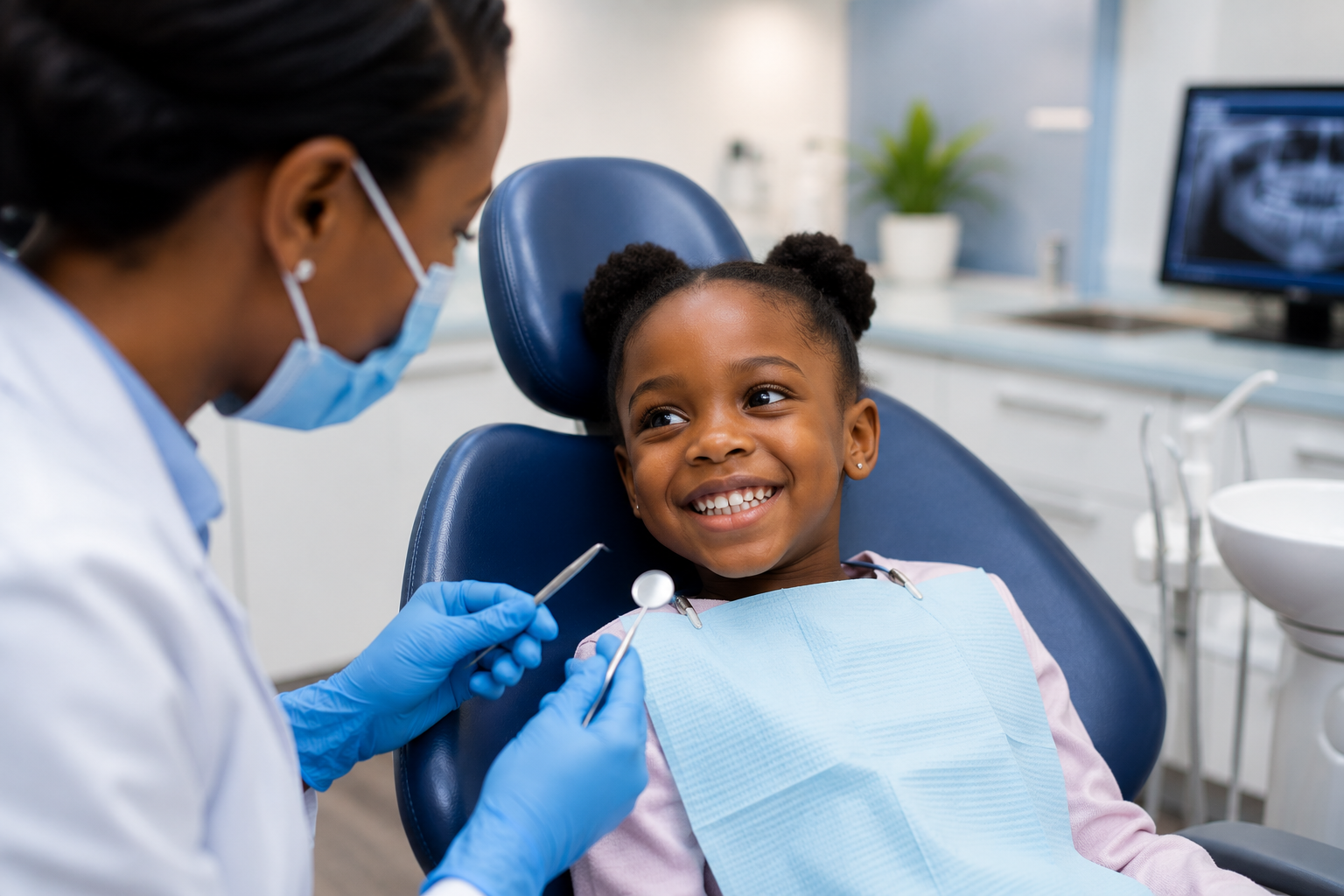
The first dental visit for a young child is very different from an adult appointment. The University of Rochester Medical Center describes it well: the initial visit typically lasts between 30 and 45 minutes and is primarily about building a relationship between the child, the parent, and the dental team.⁴
Depending on the child’s age, the appointment may include:
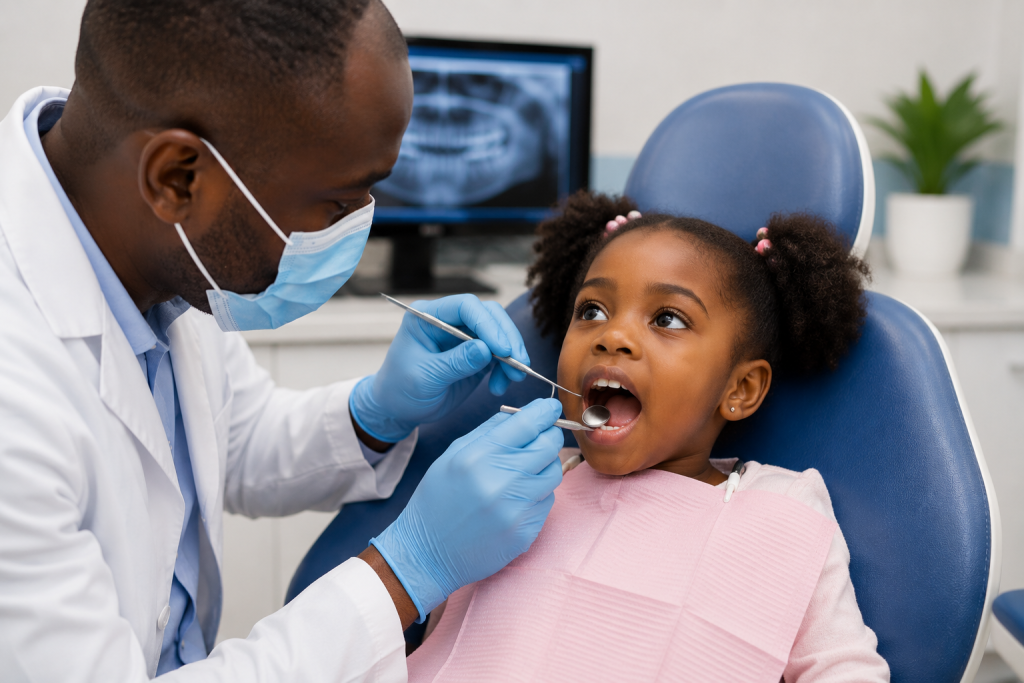
A thorough examination of the teeth, gums, jaw, bite, and oral tissues to assess growth and development. The dentist is checking that the teeth are erupting in the correct sequence, that the jaw is developing normally, and that there are no early signs of decay or gum problems.
A gentle cleaning if appropriate — removing any plaque, tartar, or staining that may have begun to accumulate on the baby teeth.
Fluoride guidance — the dentist will advise on whether fluoride toothpaste is appropriate for the child’s age, how much to use, and how to apply it correctly.
Anticipatory guidance for parents — this is one of the most valuable parts of the first visit. The dentist will provide personalised information on topics including how to clean baby teeth at home, feeding habits that increase cavity risk, thumb and finger sucking, dummy (pacifier) use, teething, and how to reduce the risk of early childhood caries.⁴
X-rays are not typically taken at the very first visit unless there is a specific clinical reason to do so.
What is Early Childhood Caries and Why Does It Matter?
Early childhood caries (ECC) is tooth decay in children younger than six years of age. It is the most common chronic disease in this age group and, if left untreated, it can have serious consequences that extend well beyond the mouth.
The Pediatrics (2023) clinical report by Krol and Whelan describes these consequences clearly: untreated ECC causes pain, difficulty eating, disrupted sleep, problems with speech development, impaired learning at school, and a reduced quality of life overall.¹ In severe cases, dental surgery under general anaesthesia is required — this is, in fact, one of the most common surgical procedures performed on preschool children in countries where ECC is not addressed early.
ECC develops through a combination of factors: the bacteria Streptococcus mutans, which produces acid that dissolves tooth enamel; dietary sugar that feeds those bacteria; the frequency and duration of exposure to sweet foods or drinks; and the quality of oral hygiene.¹ Babies who are put to bed with a bottle containing anything other than water, children who snack on sugary foods frequently throughout the day, and those whose teeth are not brushed properly are all at elevated risk.
One detail that many parents find surprising: Streptococcus mutans is transmitted from parent or caregiver to child. Strong evidence, referenced in the Pediatrics report, shows that mothers are a primary source of this bacterial transmission, often through sharing utensils, cleaning a dummy with their own mouth, or kissing the child on or near the mouth.¹ This is why the oral health of the primary caregiver matters — protecting your own teeth is part of protecting your child’s.
The Consequences of Waiting
The Padung et al. study (2022) provides a sharp illustration of what happens when early dental visits do not take place. Among 133 children attending for their first dental appointment, the youngest child requiring treatment for caries-related complications was just two years old — attending due to toothache. The predominant treatment needs were restorations (47%), pulp therapy for infected teeth (29.9%), and extractions (21.6%).²
These are not minor interventions. Pulp therapy and extractions in young children frequently require local anaesthesia, behaviour management strategies, and in some cases sedation. They are stressful for the child, emotionally difficult for parents, and significantly more costly than the preventive care that could have avoided them entirely.
As Padung et al. concluded: the longer a child’s first dental visit is delayed, the greater the chance they will develop serious dental problems that deteriorate rapidly without prompt care.²
How to Prepare Your Child for Their First Visit
The first dental visit sets the tone for how your child will feel about dental care for the rest of their life. A positive first experience builds trust. A frightening one — often the result of a first visit that involves pain or complex treatment — can create dental anxiety that persists into adulthood.
The University of Rochester Medical Center offers practical guidance on preparing for the first visit that aligns with what we do at DentMind CBD:⁴
Schedule the appointment at the right time of day. For young children, morning appointments work best. Children tend to be more alert, cooperative, and less overtired in the morning than in the afternoon.
Prepare your child with age-appropriate information. For a toddler or preschooler, give them a simple, calm explanation of what will happen — the chair, the bright light, the person who will look inside their mouth. Frame it positively and matter-of-factly. Do not build it up into a big event or, equally, do not warn them about pain or drills.
Watch your own language around dentist visits. Children absorb parental anxiety very efficiently. If you personally feel anxious or negative about dental care, be careful not to communicate those feelings to your child — even indirectly. Your calm presence in the room is one of the most powerful tools for keeping a young child settled.⁴
Bring health history information. On the first visit, the dentist will want to know about your child’s birth history, general health, any medications, feeding history, and oral hygiene routine at home. Having this information ready makes the appointment more efficient and more useful.
What Parents Can Do at Home Between Visits
The first dental visit is the beginning of a partnership between your family and your dental team — not a once-off event. Between visits, there is a great deal parents can do to protect their child’s developing teeth.
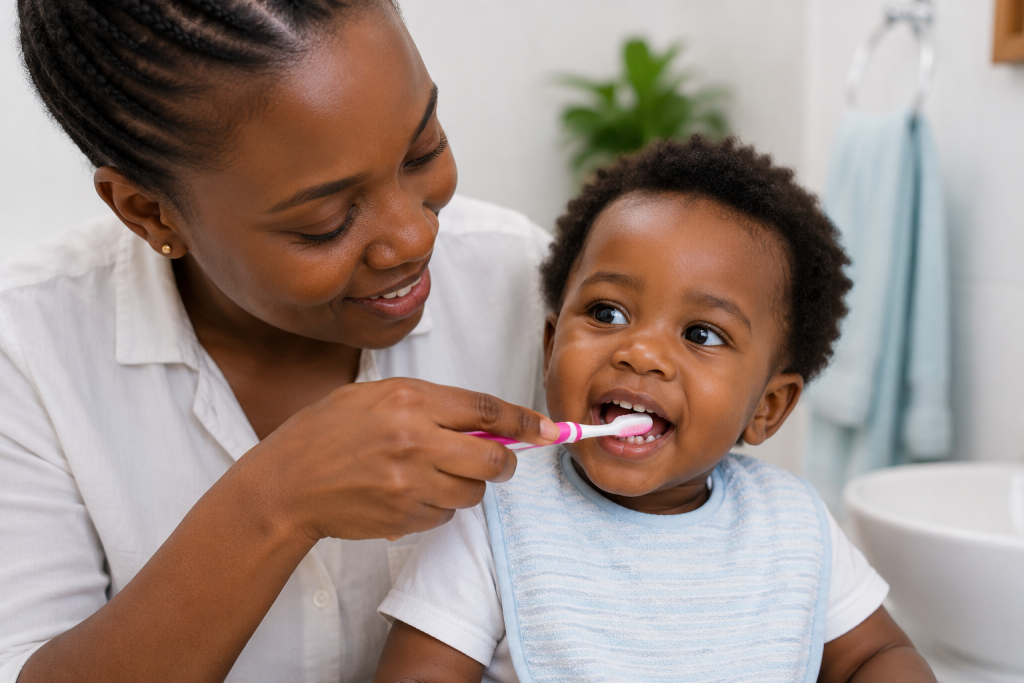
Start cleaning teeth as soon as the first tooth appears. The Pediatrics (2023) clinical report recommends brushing a child’s teeth twice a day with a grain-of-rice-sized amount of fluoridated toothpaste as soon as the first tooth erupts. From age three, increase to a pea-sized amount.¹
Supervise brushing until around age ten. Most children lack the fine motor control to brush their own teeth effectively until approximately ten years of age. Parents should assist with and monitor brushing until mastery is demonstrated.¹
Limit sugar frequency, not just sugar quantity. The risk of caries is greatest when sugars are consumed frequently throughout the day, keeping the oral environment acidic for extended periods. Limiting sugary snacks and drinks to mealtimes significantly reduces cavity risk.¹
Do not put a child to bed with a bottle containing anything other than water. This is one of the highest-risk habits for early childhood caries. Milk, juice, or formula sitting on the teeth overnight creates the perfect conditions for decay.
Never clean a dummy or utensil with your own mouth. As noted above, this is one of the main ways caries-causing bacteria are transmitted from parent to child.¹
Book check-ups every six months. After the first visit, the dentist will advise on how frequently the child should return. Most children are seen every six months, though those at higher caries risk may be seen more often.
What About Children Who Are Afraid of the Dentist?
Dental anxiety in children is common and understandable. The best way to prevent it is to start early, before there is ever a reason to associate the dentist with pain. Children who have their first visit in infancy or toddlerhood — when no treatment is needed — typically develop a relaxed, matter-of-fact attitude toward dental care.
At DentMind CBD on Kimathi Street, we see children regularly and our team is comfortable working with young patients. We pace the first visit gently, allow the child to explore the environment, and focus on making the experience as positive as possible. If your child is anxious, tell us before the appointment. We can adapt the approach accordingly.
The Alai-Towfigh et al. survey (2022) found that dentists who actively encouraged early childhood visits, whose staff were comfortable with young patients, and who used age-appropriate examination techniques had significantly better outcomes in terms of parents actually bringing their children in — and children having better first experiences.³ That culture of welcome is something we work to maintain at DentMind CBD.
Frequently Asked Questions
My child has not grown any teeth yet. Should I still visit the dentist? The first visit is recommended by twelve months of age regardless of how many teeth have appeared. At this visit the dentist can assess development, provide guidance on what to expect, and advise on cleaning the gums even before teeth erupt.
My child’s baby teeth will fall out anyway. Does it really matter if they decay? Yes, significantly. Baby teeth hold space for the permanent teeth developing beneath them. Early loss of baby teeth due to decay can cause the surrounding teeth to shift, leading to crowding and misalignment of the adult teeth. Baby teeth also affect speech, chewing, and your child’s ability to eat a nutritious diet.
How do I know if my child has early childhood caries? Early signs include white or chalky spots on the teeth (particularly near the gumline), discolouration, or visible holes. However, early caries can be difficult to see without professional examination. The best way to detect it early is through regular dental check-ups.
What if my child refuses to open their mouth at the dentist? This is very common, especially with young children. Our team at DentMind CBD is experienced in working with uncooperative or anxious children and has strategies to manage these situations calmly. It is rarely a reason to avoid or delay the visit.
Is fluoride toothpaste safe for babies and toddlers? Yes. The Pediatrics (2023) AAP clinical report confirms that fluoride toothpaste is safe and effective for children from the time of first tooth eruption, using a grain-of-rice-sized amount. After age three, increase to a pea-sized amount. The key is using the correct quantity and not allowing the child to swallow large amounts.¹
Book Your Child’s First Dental Visit at DentMind CBD
If your child has not yet seen a dentist, the best time to book is now. Whether your child is an infant with their first tooth just appearing, a toddler, or a school-age child who has never been to the dentist, we welcome them at DentMind CBD Dental Centre.
Early visits are easier, quicker, and far less stressful for children than waiting until there is a problem. They also cost far less in the long run. The research is clear: establishing a dental home by one year of age sets children on a path toward better oral health that lasts a lifetime.³
Our team on Kimathi Street is open seven days a week and is experienced in caring for young patients in a calm, child-friendly environment. To book an appointment, call us or visit our website.
DentMind CBD Dental Centre Victor House, Third Floor, Kimathi Street, Nairobi CBD 📞 0715 063640 🌐 www.dentmindcbd.co.ke Open Monday to Sunday
Footnotes
¹ Krol, D. M., Whelan, K., & AAP Section on Oral Health. (2023). Maintaining and improving the oral health of young children. Pediatrics, 151(1), e2022060417. https://doi.org/10.1542/peds.2022060417
² Padung, N., Singh, S., & Awasthi, N. (2022). First dental visit: Age, reasons, oral health status and dental treatment needs among children aged 1 month to 14 years. International Journal of Clinical Pediatric Dentistry, 15(4), 394–397. https://doi.org/10.5005/jp-journals-10005-2406
³ Alai-Towfigh, H., Schroth, R. J., Hu, R., Lee, V. H. K., & Olatosi, O. (2022). Canadian dentists’ views on the first dental visit for children. Frontiers in Oral Health, 3, 957205. https://doi.org/10.3389/froh.2022.957205
⁴ University of Rochester Medical Center. (2026). A child’s first dental visit fact sheet. Health Encyclopedia. Retrieved from https://www.urmc.rochester.edu/encyclopedia/content?contenttypeid=1&contentid=1509