A claim keeps doing the rounds on social media and in family WhatsApp groups: the fluoride in your toothpaste is quietly calcifying your pineal gland, the small “third eye” deep in the brain, and making you sleepy, passive and easy to control. It sounds alarming, and it gets shared because it sounds alarming. So, is fluoride toothpaste safe, or have dentists been getting it wrong for generations?
At DentMind CBD, patients ask us this more often than you might expect. Rather than dismiss the question, we went back to the research itself. Not blogs, not podcasts, not forwarded voice notes, but peer-reviewed studies published in scientific journals, from the 1940s right up to 2025. What we found is more interesting than either side of the argument usually admits.
Where the Pineal Gland Claim Comes From
The pineal gland is a pea-sized structure in the centre of the brain. Its best-known job is producing melatonin, the hormone that tells your body when it is time to sleep. Because it sits so deep and was linked by early philosophers to the soul, it has attracted a fair amount of mysticism over the centuries.
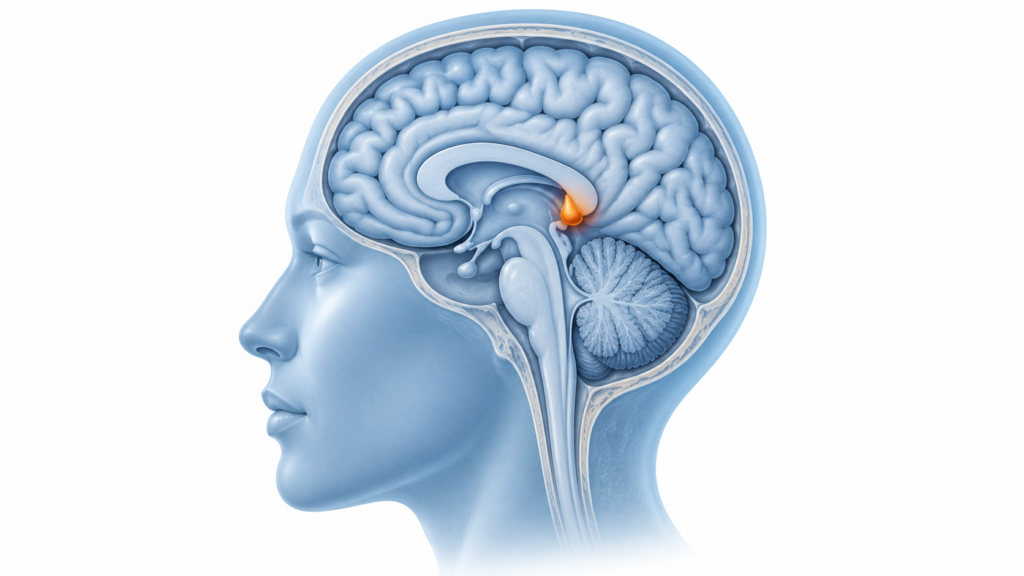
The modern fluoride claim stitches together three separate ideas. First, that fluoride builds up in the pineal gland. Second, that this build-up damages the gland. Third, that a damaged gland makes people docile. As we will see, the first idea has genuine scientific support, the second is unproven, and the third has never been tested in any peer-reviewed study at all.
To understand how these ideas got tangled together, it helps to follow the research in the order it actually happened.
1942: How Fluoride Entered Dentistry
The story starts in the United States in the 1930s and 1940s. A public health dentist named H. Trendley Dean noticed that children in some towns had mottled, stained enamel, yet surprisingly few cavities. The common factor was naturally occurring fluoride in the local drinking water.
In a landmark 1942 study of 4,425 children across 13 cities, Dean and his colleagues showed that children who drank water containing around one part per million of fluoride had markedly lower rates of tooth decay than children whose water had almost none.¹ That single finding launched decades of research into fluoride as a tool for preventing cavities.
Notice what Dean was studying, though. It was fluoride people drank every day, absorbed into the body while their teeth were still forming. That distinction between fluoride you swallow and fluoride you brush on will matter a great deal later in this story.
2001: The Study That Started the Pineal Gland Debate
Almost sixty years later, a British researcher named Jennifer Luke asked a sensible question. The pineal gland is one of the few soft tissues in the body that naturally collects calcium deposits as we age. Fluoride has a strong attraction to calcium. Could fluoride be building up there too?
Her study, published in Caries Research in 2001, examined the pineal glands of 11 elderly people after death.² She found that fluoride had indeed accumulated in the calcified parts of the gland, at levels far higher than in surrounding muscle tissue, and that the more calcium a gland contained, the more fluoride it held.²
This is the study almost every online fluoride warning points back to, and it is a real finding in a real journal. But it is worth being precise about what it showed and what it did not.
It showed that fluoride accumulates in pineal calcifications by old age. It did not measure whether those glands produced less melatonin, whether their owners slept differently, or whether anyone’s mood or behaviour changed. It looked at 11 people, all elderly, after death. As a starting point for further research, it was valuable. As proof that toothpaste switches off the brain, it simply does not stretch that far.
What Pineal Calcification Really Means
If fluoride is collecting in calcium deposits, the next question is where those deposits come from in the first place. A 2018 review in the journal Molecules brought together decades of research on exactly this.³
The authors noted that the pineal gland has the highest rate of calcification of any organ in the human body, and that the process appears to be active and linked to ageing, in some ways resembling how bone forms.³ They also reported that heavier calcification is associated with reduced melatonin output and with a range of neurological conditions.³
What the review does not do is name fluoride as the cause of pineal calcification. Calcification happens in people everywhere, including in populations with very little fluoride exposure. So the more accurate picture is this: the gland calcifies with age for reasons still being studied, and fluoride, being attracted to calcium, gets caught up in those deposits along the way.
From Calcification to Sleep: What Later Studies Found
If fluoride really interfered with the pineal gland in a meaningful way, you would expect to see it in people’s sleep. Two population studies have looked for exactly that.
In 2019, researchers analysed data from American teenagers aged 16 to 19 and found associations between fluoride exposure and certain sleep patterns.⁴ The authors were careful, however. Their study was cross-sectional, meaning it captured a single moment in time and could not show that fluoride caused any change. They called for further long-term research before drawing firm conclusions.⁴
A follow-up study in 2021 examined a large Canadian sample of adolescents and adults.⁵ It found a possible link between higher fluoride exposure and sleeping less than the recommended number of hours. Importantly for the “docile” claim, it found no significant association between fluoride levels and daytime sleepiness or the frequency of sleep problems.⁵
So the best available human evidence points, at most, to a small and uncertain effect on sleep timing or duration, linked to fluoride people drink over years. Nothing in this research describes people becoming passive, obedient or easier to control. That part of the claim has no scientific source behind it.
The Debate That Is Genuinely Live: High Fluoride and Children
Here is where honesty matters, because there is a real scientific debate about fluoride, and it is not about the pineal gland.
In January 2025, scientists from the US National Institute of Environmental Health Sciences published a large review in JAMA Pediatrics covering 74 studies on fluoride exposure and children’s IQ.⁶ They found that higher fluoride exposure was associated with slightly lower IQ scores, with each one milligram per litre increase in fluoride measured in children’s urine linked to a drop of about 1.6 IQ points.⁶
Crucially, the authors reported that the evidence was limited and uncertain when drinking water contained less than 1.5 milligrams of fluoride per litre, the upper limit recommended by the World Health Organization.⁶ Most of the studies came from areas with naturally high fluoride in groundwater, and many were rated as carrying a high risk of bias. The review was also challenged by other researchers in the same journal, and the scientific discussion is ongoing.
Two points stand out for anyone worried about their toothpaste. First, this debate concerns fluoride that children swallow, mostly through drinking water, during early development. Second, it concerns levels well above what a person would absorb from brushing their teeth properly.
So, Is Fluoride Toothpaste Safe?
This brings us back to that distinction from 1942. Dean was studying fluoride people drank. Luke, the sleep researchers and the IQ reviewers were all, in one way or another, looking at fluoride that enters the bloodstream over long periods. Toothpaste works differently.
Fluoride in toothpaste acts mainly on the surface of your teeth. It helps rebuild weakened enamel and makes teeth more resistant to the acids produced by bacteria after you eat. You brush, you spit, and only a tiny amount is swallowed, particularly if you spit rather than swallow and avoid eating the paste.
On whether it works, the evidence is about as strong as dentistry gets. A 2019 Cochrane review, one of the most rigorous forms of medical evidence, pooled randomised controlled trials and confirmed that fluoride toothpaste prevents tooth decay in children, teenagers and adults compared with non-fluoride toothpaste.⁷ It also found that higher fluoride concentrations prevent more decay, while noting that the strength used for young children should be balanced against the risk of dental fluorosis.⁷ You can read the full Cochrane review here.
In short, for teenagers and adults brushing twice a day and spitting out the excess, fluoride toothpaste is safe and effective. For young children, the amount matters, which is where the next section becomes very relevant to families in Kenya.
The Fluoride Problem Kenya Actually Has
Unlike some countries, Kenya does not add fluoride to public water supplies. Yet large parts of the country, especially along the Rift Valley, have groundwater that is naturally rich in fluoride because of the volcanic rock it passes through.
A 2023 study examined 215 adolescents living in suburbs around Nairobi where families rely on high-fluoride groundwater.⁸ Around 78.6% showed mild to severe dental fluorosis, the white flecks, brown stains and, in serious cases, pitting of the enamel caused by swallowing too much fluoride while teeth are forming.⁸ The researchers noted that water in rural areas around Nairobi often exceeds the 1.5 parts per million recommended by the World Health Organization.⁸
This is the real fluoride story for many Kenyans. The concern is not a few milligrams of toothpaste spat into the sink. It is years of drinking untreated borehole or well water during childhood. If you grew up in Nakuru, Naivasha, Kajiado or similar areas and have brown or mottled teeth, there is a good chance this is the reason, and it is a cosmetic and structural issue that modern dentistry can treat.
Facts and Fiction at a Glance
Bringing the research together, here is where the evidence currently stands.
| Claim | What the peer-reviewed research shows |
|---|---|
| Fluoride builds up in the pineal gland | Fact. Fluoride accumulates in age-related pineal calcifications (2001). |
| Fluoride causes the pineal gland to calcify | Unproven. Calcification is common with ageing in all populations (2018). |
| Fluoride affects sleep | Uncertain. Small associations with sleep timing or duration; cause not shown (2019, 2021). |
| Fluoride makes people docile | Fiction. No peer-reviewed study has ever shown this. |
| Very high fluoride intake may affect children’s development | Under active debate. Linked mainly to high-fluoride drinking water (2025). |
| Fluoride toothpaste prevents tooth decay | Fact. Supported by high-quality Cochrane evidence (2019). |
| Kenyans face too much fluoride from water | Fact in many regions. High fluorosis rates near Nairobi (2023). |
Using Fluoride Toothpaste the Right Way
Good evidence is only useful if it changes what happens at the bathroom sink. These habits give you the benefits of fluoride while keeping swallowed amounts to a minimum.
- Spit, do not rinse. After brushing, spit out the excess but avoid rinsing heavily with water, so the fluoride stays on your teeth a little longer.
- Supervise young children. Use only a smear of toothpaste for children under three and a pea-sized amount from three to six, and teach them to spit rather than swallow.
- Check your water source. If your household drinks borehole or well water, especially in the Rift Valley, ask your water provider about fluoride levels or consider a filter designed to remove fluoride.
- Keep toothpaste out of reach. Flavoured children’s toothpaste can be tempting to eat straight from the tube.
- Ask your dentist. If you are unsure which toothpaste strength suits you or your children, a dentist can advise based on your cavity risk and where you live.
Fluoride has been studied for more than eighty years, and the science has moved forward rather than backward. The pineal gland finding is real but narrow, the idea of toothpaste making people docile has no evidence behind it, and the genuine concern in Kenya is fluoride in drinking water rather than in your toothpaste. If you have questions about the right toothpaste for your family, or you are bothered by the brown stains of fluorosis, our team at DentMind CBD on Kimathi Street would be glad to help, and you can book an appointment online or simply message us on WhatsApp to arrange a visit.
References
¹ Dean, H. T., Arnold, F. A., & Elvove, E. (1942). Domestic water and dental caries: V. Additional studies of the relation of fluoride domestic waters to dental caries experience in 4,425 white children, aged 12 to 14 years, of 13 cities in 4 states. Public Health Reports, 57(32), 1155–1179.
² Luke, J. (2001). Fluoride deposition in the aged human pineal gland. Caries Research, 35(2), 125–128.
³ Tan, D. X., Xu, B., Zhou, X., & Reiter, R. J. (2018). Pineal calcification, melatonin production, aging, associated health consequences and rejuvenation of the pineal gland. Molecules, 23(2), 301. https://doi.org/10.3390/molecules23020301
⁴ Malin, A. J., Bose, S., Busgang, S. A., Gennings, C., Thorpy, M., Wright, R. O., Wright, R. J., & Arora, M. (2019). Fluoride exposure and sleep patterns among older adolescents in the United States: A cross-sectional study of NHANES 2015–2016. Environmental Health, 18, 106. https://doi.org/10.1186/s12940-019-0546-7
⁵ Cunningham, J. E. A., McCague, H., Malin, A. J., Flora, D., & Till, C. (2021). Fluoride exposure and duration and quality of sleep in a Canadian population-based sample. Environmental Health, 20.
⁶ Taylor, K. W., Eftim, S. E., Sibrizzi, C. A., et al. (2025). Fluoride exposure and children’s IQ scores: A systematic review and meta-analysis. JAMA Pediatrics. https://doi.org/10.1001/jamapediatrics.2024.5542
⁷ Walsh, T., Worthington, H. V., Glenny, A. M., Marinho, V. C. C., & Jeroncic, A. (2019). Fluoride toothpastes of different concentrations for preventing dental caries. Cochrane Database of Systematic Reviews, (3), CD007868. https://doi.org/10.1002/14651858.CD007868.pub3
⁸ Demarchi, P., Garbarino, F., Mascolo, A., Silvestrini Biavati, F., & Ugolini, A. (2023). Fluorosis and oral health status in adolescents living in a high-fluoride groundwater area: A case study of Nairobi suburbs (Kenya). Applied Sciences, 13(1), 368. https://doi.org/10.3390/app13010368