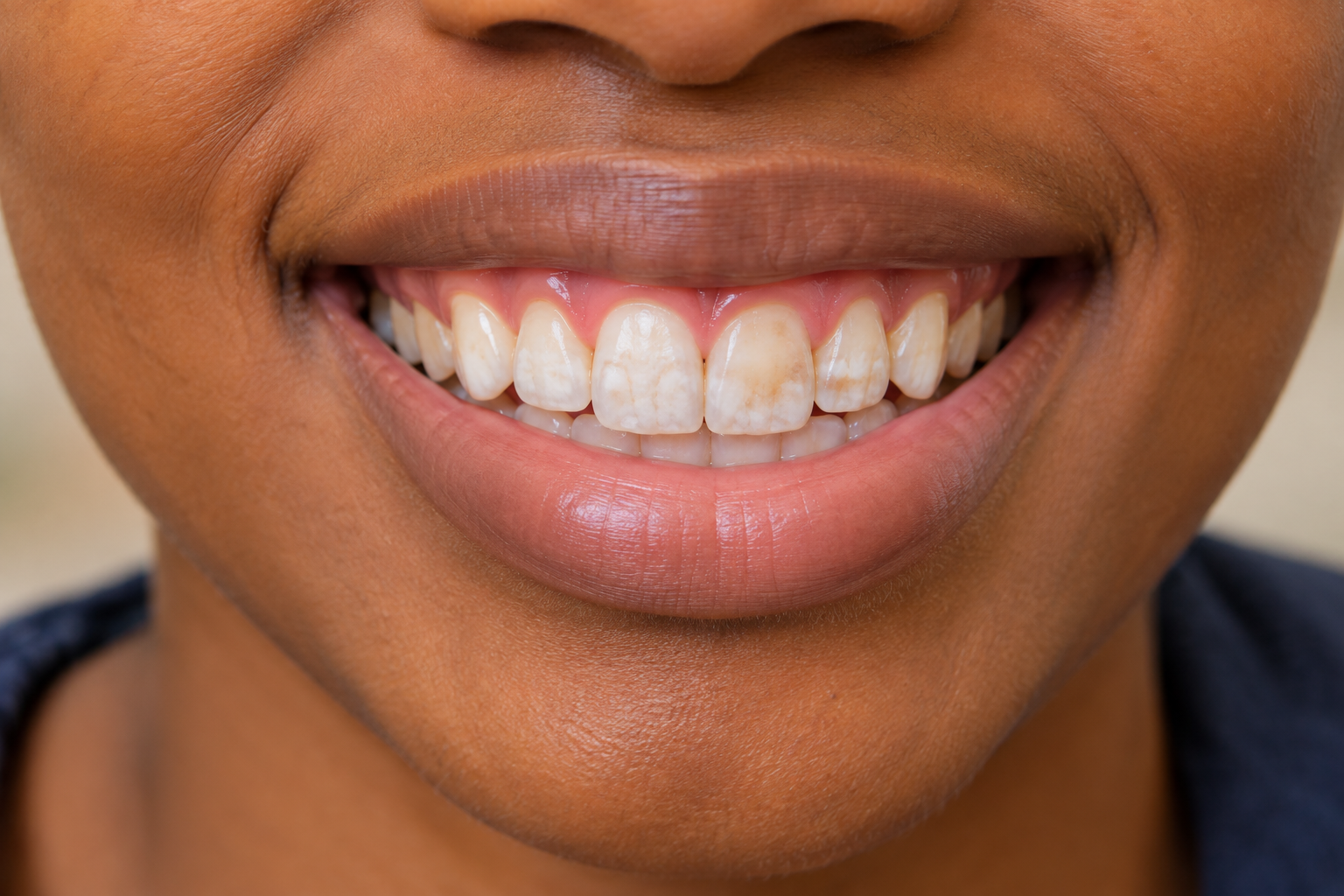
If you grew up in Nakuru, Naivasha or Kajiado, or in a borehole-served estate on the edge of Nairobi, you have probably seen it. Teeth with chalky white flecks, yellow streaks or brown patches that no amount of brushing will shift. Many people simply call them “brown teeth”. The proper name is dental fluorosis, and it is far more common in Kenya than most people realise.
Dental fluorosis in Kenya is closely tied to the water people drink as young children, particularly borehole and well water drawn from volcanic rock in and around the Rift Valley. The good news is that it is not an infection, it does not spread, and in most cases the appearance of affected teeth can be improved considerably.
This guide explains what dental fluorosis is, why the Rift Valley carries so much fluoride, what the picture looks like around Nairobi, how to recognise the condition, and what can be done. That includes treating stains that are already there and protecting the next generation from developing them.
What Is Dental Fluorosis?
Dental fluorosis is a change in tooth enamel (the hard outer layer) that develops when a child takes in too much fluoride while their teeth are still forming beneath the gums.¹ Once the tooth has formed, the marks are locked into the enamel itself. That is why brushing, whitening toothpaste and home remedies cannot remove them.
Fluoride itself is not the enemy. At the right level, it strengthens enamel and helps prevent tooth decay. Researchers generally regard 0.5 to 1.0 mg of fluoride per litre of drinking water as beneficial, whereas levels above 1.5 mg per litre are linked to fluorosis.² The problem, in other words, is the dose. When children drink water carrying several times that amount day after day, the process that builds their enamel is disrupted, leaving it more porous and mottled.
Timing matters too. The period of greatest risk is early childhood, while the permanent teeth are developing. For the upper front teeth, the most sensitive window is thought to be roughly 15 to 30 months of age.¹ Teeth that have already fully formed do not develop these marks later, which is why the condition is really a record of the water someone drank as a toddler.
Why Is Fluoride So High in Kenya’s Rift Valley?
Kenya sits on the East African Rift, one of the most volcanically active regions in the world. The rocks there are naturally rich in fluoride. A review of groundwater across sub-Saharan Africa found that fluoride levels tend to be higher in East Africa, largely because of volcanic activity in the rift system.² Geothermal heat adds to the problem, particularly in deep aquifers and hot springs.²
A 2022 study of shallow aquifers across the Kenyan Rift Valley showed just how serious the situation is. More than 40% of groundwater samples exceeded the World Health Organization (WHO) guideline of 1.5 mg per litre, and some reached 23.5 mg per litre, more than fifteen times the limit.³

The researchers also found that the highest-fluoride water shared a clear chemical signature. It was rich in sodium, low in calcium and alkaline.³ Put simply, as water moves slowly through weathered volcanic rock, fluoride dissolves out of it. With little calcium present to bind the fluoride, it stays in the water that ends up in household taps, tanks and jerrycans.
Importantly, the same study identified children as the group facing the greatest health risk from drinking this water.³ That makes sense, because children drink a lot of water relative to their body size, and their teeth are still forming.
This is not a small or local issue. Across Africa, groundwater is the main drinking supply for more than 400 million people, and rural households in particular often have no easy alternative to boreholes and wells.²
What About Nairobi?
Nairobi sits on the eastern shoulder of the rift, and its picture is more mixed. Much of the city’s piped supply comes from surface water such as rivers and dams, which is generally lower in fluoride. However, many estates, schools, institutions and businesses on the outskirts rely on boreholes, and some of those draw water with considerably higher fluoride levels.⁴
When researchers examined 215 adolescents living in Nairobi’s suburbs, they found that 78.6% had some degree of fluorosis, ranging from mild to severe.⁴ That was one group in one area, so it should not be read as a figure for the whole city. Even so, it shows that fluorosis is not only a “Nakuru problem”, and that families in and around Nairobi benefit from knowing exactly where their water comes from.
A useful question to ask yourself is simple. Was the water you drank as a young child from a borehole, a well or a piped municipal supply? If you grew up on borehole water in the Rift Valley, or in a borehole-served area near Nairobi, fluorosis is a likely explanation for mottled teeth.
How to Recognise Dental Fluorosis
Fluorosis varies a great deal from one person to another. Dentists grade it by severity, and the signs typically progress as follows:¹
- Very mild to mild: thin white lines or small chalky white flecks, often on the front teeth. Many people barely notice them.
- Moderate: larger cloudy white areas, sometimes with yellow or light brown staining across the surface of the tooth.
- Severe: dark brown patches and pitting (small holes in the enamel surface). In the worst cases, parts of the enamel break away and the tooth changes shape.
A few features help to tell fluorosis apart from ordinary staining. First, it usually affects several teeth in a symmetrical pattern, often matching teeth on both sides of the mouth. Second, the marks sit within the enamel rather than on top of it, so a routine scale and polish will not lift them. Third, it tends to appear across families and neighbours who shared the same water source.
That said, not every white spot or brown mark is fluorosis. Early tooth decay, enamel damage, stains from tea, coffee or tobacco, and certain developmental conditions can all look similar. A dental examination is the only reliable way to know what you are dealing with, and it matters because the right treatment depends on the cause.
The Hidden Impact of “Normal” Brown Teeth
In communities where almost everyone has mottled teeth, the condition can start to feel normal. A 2025 study from a high-fluoride region of Cameroon, which shares similar geology with parts of East Africa, found that 90% of residents regarded brown teeth as normal. About three in four also believed that discoloured teeth could not be treated at a dental clinic.¹
Kenyan research points to a similar pattern. In a 2026 study of households in Nakuru, 81% of participants had good knowledge of fluoride and fluorosis, yet 67% showed little or no concern about it.⁵ More worryingly, 65% relied on practices that do not work, such as boiling or chemically treating their water, or scrubbing their teeth repeatedly in an attempt to remove the stains.⁵
Two points are worth stating plainly. Boiling water does not remove fluoride. And hard brushing does not remove fluorosis; over time, it only wears down the gums and the enamel you are trying to protect.
The Nakuru researchers also noted that stigma and other social and emotional effects may call for wider community responses.⁵ Many people with visible fluorosis cover their mouths when they laugh, avoid smiling in photographs or feel self-conscious in interviews and meetings. These effects are real, even when the teeth themselves are otherwise healthy.
Can Dental Fluorosis Be Treated?
Yes. The marks cannot be washed out, but the appearance of fluorosed teeth can usually be improved considerably. The right approach depends mainly on how severe the fluorosis is.¹ Broadly, the options fall into four groups.
Professional Teeth Whitening
Professional whitening lightens the overall shade of the teeth. As a result, white flecks tend to blend in, and mild brown staining becomes less obvious. On its own, whitening rarely hides every mark, but it is often a valuable first step. You can read more in our guide to teeth whitening in Nairobi CBD.
Resin Infiltration
Resin infiltration is a minimally invasive treatment that involves no drilling. A very fluid, tooth-coloured resin is drawn into the porous enamel of the affected areas and then hardened with a light. Because the treated enamel reflects light more like healthy enamel, the marks become much less visible.
The research here is encouraging. A 2021 systematic review found that resin infiltration masked white enamel marks more effectively than no treatment.⁶ Furthermore, a 2024 systematic review and meta-analysis concluded that whitening followed by resin infiltration was the most effective way to mask fluorosis spots on front teeth in young adults.⁷
Microabrasion
Microabrasion gently removes a very thin surface layer of stained enamel using a mild abrasive paste. It works best for shallow, surface-level marks and is often combined with whitening for a more even result.
Veneers, Bonding and Crowns
For moderate to severe fluorosis with deep brown staining or pitting, surface treatments may not be enough. In these cases, composite bonding or veneers (thin, tooth-coloured shells bonded to the front of the teeth) can cover the damage. Where enamel loss has changed the shape of a tooth, a crown may be the most durable option.¹ Explore our cosmetic dentistry services to see how these treatments work.
In general, your dentist will recommend the least invasive option that achieves the result you want, and many patients do best with a combination of treatments.
How to Protect Children From Fluorosis
Because fluorosis forms in early childhood, prevention focuses on young children, particularly in the years when their permanent teeth are developing. Here are the most practical steps for families.
Know your water. If your household uses a borehole or well, especially in the Rift Valley or on the outskirts of Nairobi, have the water tested for fluoride at an accredited laboratory. Anything above 1.5 mg per litre exceeds the WHO guideline.³
Choose safer water for young children. Where local water is high in fluoride, options include harvested rainwater, blending borehole water with a lower-fluoride supply, and defluoridation filters that remove fluoride at household or community level.² Remember that boiling will not help.⁵
Use toothpaste the right way. Fluoride toothpaste remains one of the best protections against tooth decay, so the goal is not to avoid it. Instead, it is about using the right amount. A 2024 Cochrane review found that children who started brushing with toothpaste containing 1,000 ppm fluoride or more between the ages of one and two were likely to have a higher chance of fluorosis in their permanent teeth, although the certainty of that evidence was often low.⁸ In practice, that means a smear the size of a grain of rice for children under three, a pea-sized amount from three to six, supervised brushing, and teaching children to spit out rather than swallow. This matters even more in high-fluoride areas, where children already take in plenty from their water.
Start dental visits early. A children’s dentist can spot early enamel changes and advise on the right fluoride routine for your family’s situation. Learn more about our children’s dentistry care.
Living With Fluorosis as an Adult
If you already have fluorosis, there is no need to worry that it will spread or suddenly worsen on its own; it formed many years ago. In mild to moderate cases, the enamel is generally sound, and good daily care still keeps teeth healthy. In more severe cases, pitted or broken enamel may wear more easily, so regular check-ups are worthwhile.
It is also worth remembering that high-fluoride water matters beyond the teeth. Long-term exposure to very high fluoride levels is linked to skeletal fluorosis, which affects the bones and joints.¹ So if your household still drinks from a high-fluoride borehole, testing the water and finding a safer supply benefits everyone at home, not only the children.
A Final Word on Brown Teeth
Dental fluorosis is part of life for many Kenyans, but it does not have to define your smile. Understanding where it comes from helps families protect young children, and modern dentistry offers real options for adults who want to feel confident again. If white flecks or brown marks have been holding you back, the team at DentMind CBD Dental Centre, on the third floor of Victor House on Kimathi Street, can examine your teeth, confirm whether fluorosis or something else is behind the marks, and talk you through options from whitening to resin infiltration and veneers. We are open Monday to Sunday, so you can book an appointment online, message us on WhatsApp, or find us on Google Maps whenever it suits you.
3. References
¹ Ebot, E. B., Agbor, A. M., & Naidoo, S. (2025). Risk factors of dental fluorosis and fluoride content in drinking water in the far north region of Cameroon. Saudi Journal of Oral Sciences, 12(1), 61–71. https://doi.org/10.4103/sjoralsci.sjoralsci_74_24
² Onipe, T., Edokpayi, J. N., & Odiyo, J. O. (2020). A review on the potential sources and health implications of fluoride in groundwater of Sub-Saharan Africa. Journal of Environmental Science and Health, Part A, 55(9), 1078–1093. https://doi.org/10.1080/10934529.2020.1770516
³ Mwiathi, N. F., Gao, X., Li, C., & Rashid, A. (2022). The occurrence of geogenic fluoride in shallow aquifers of Kenya Rift Valley and its implications in groundwater management. Ecotoxicology and Environmental Safety, 229, 113046. https://doi.org/10.1016/j.ecoenv.2021.113046
⁴ Demarchi, P., Garbarino, F., Mascolo, A., Silvestrini Biavati, F., & Ugolini, A. (2023). Fluorosis and oral health status in adolescents living in a high-fluoride groundwater area: A case study of Nairobi suburbs (Kenya). Applied Sciences, 13(1), 368. https://doi.org/10.3390/app13010368
⁵ Okore, L. A., Aggarwal, R., Awuor, D. R., & Owuor, P. M. (2026). Knowledge, attitudes, behaviors, and consequences of geogenic fluoride exposure on oral and dental health in Nakuru, Kenya. Frontiers in Oral Health, 7, 1775671. https://doi.org/10.3389/froh.2026.1775671
⁶ Bourouni, S., Dritsas, K., Kloukos, D., & Wierichs, R. J. (2021). Efficacy of resin infiltration to mask post-orthodontic or non-post-orthodontic white spot lesions or fluorosis: A systematic review and meta-analysis. Clinical Oral Investigations. https://doi.org/10.1007/s00784-021-03931-7
⁷ Wittich, F. K., Cebula, M., Effenberger, S., Schoppmeier, C. M., Schwendicke, F., Barbe, A. G., & Wicht, M. J. (2024). Masking efficacy of bleaching and/or resin infiltration of fluorotic spots on anterior teeth: A systematic review and meta-analysis. Journal of Dentistry, 149, 105276. https://doi.org/10.1016/j.jdent.2024.105276
⁸ Wong, M. C. M., Zhang, R., Luo, B. W., Glenny, A.-M., Worthington, H. V., & Lo, E. C. M. (2024). Topical fluoride as a cause of dental fluorosis in children. Cochrane Database of Systematic Reviews, 2024(6), CD007693. https://doi.org/10.1002/14651858.CD007693.pub3