If you are weighing up a dental implant, one question comes up more than almost any other. How long will it actually last? It is a fair question, because an implant is not a small investment of time or trust. You want to know that the tooth you are replacing will still be doing its job in ten, fifteen, or twenty years.
The honest answer is that dental implants are one of the most durable treatments in modern dentistry, but they are not guaranteed for life. Research that has followed implants for two decades or more gives us a realistic picture of what to expect, along with the warning signs that tell you when something needs attention. This article walks through both, using the best long-term evidence available, so you know what a well-placed, well-maintained implant can offer, and what to watch for along the way.
The Short Answer: Implants Are Built for the Long Term
Most dental implants are designed to last well beyond a decade, and a large proportion go on functioning for twenty years or more. A 2024 meta-analysis pooling data from eight long-term studies, involving more than 1,600 implants followed for two full decades, found that approximately four out of five implants were still functioning after 20 years¹. That figure held even after researchers made conservative statistical adjustments for patients who dropped out of follow-up, which usually pushes survival estimates down rather than up.
Shorter-range data tells a similar story. A retrospective review of nearly 11,000 implants placed over more than two decades by a single periodontal practice found cumulative survival rates of 98.9% at three years, 98.5% at five years, 96.8% at ten years, and 94.0% at fifteen years, measured at the implant level². Looked at from the patient’s side rather than the implant’s side, survival was slightly lower, at 86% by year fifteen, largely because people with several implants carried a higher overall risk of at least one of them needing attention.
A separate Swedish study that tracked patients for nine to fifteen years after treatment recorded a cumulative implant survival rate of 82.6% at the fifteen-year mark³. The gap between these figures and the numbers above is not a contradiction. It reflects differences in patient groups, implant systems, and how strictly each study counted a “failure”. What all of this research agrees on is the broad shape of the picture: implants are highly durable, but the risk of losing one rises gradually over time rather than staying flat.
Why Implants Do Not All Last the Same Length of Time
No two mouths are identical, and no two implants age in quite the same way. Long-term data has identified several factors that consistently affect how long an implant is likely to serve you.
Smoking
Across the research, tobacco use shows up again and again as one of the strongest modifiable risk factors for implant problems. A large retrospective study of over 50,000 implants placed in a university dental clinic found that tobacco use significantly increased the risk of implant failure, even after accounting for other variables⁶. Smoking reduces blood flow to the gum and bone tissue that needs to heal and stay healthy around the implant, which makes both early failure and later complications more likely.
Diabetes and other systemic conditions
Uncontrolled diabetes was also linked to a higher rate of implant loss in the same large cohort study⁶, echoing findings from earlier implant research. This does not mean implants are off the table for people managing diabetes. It does mean that good glycaemic control before and after surgery matters, and your dentist should factor your medical history into the treatment plan.
The number of implants and the type of restoration
Interestingly, patients who received multiple implants were shown to carry a higher risk of at least one failing, with one large cohort reporting a more than five-fold increase in risk for patients with two or more implants compared with those who had just one². This is thought to relate to shared risk factors across a person’s whole mouth, such as periodontal history or bone quality, rather than any flaw in the implants themselves. Very short implants, typically 6 millimetres or less, and implants combined with bone grafting procedures were also linked to a somewhat higher chance of failure in the same research², which is worth discussing with your dentist if grafting is part of your plan.
Bone quality and healing in the first year
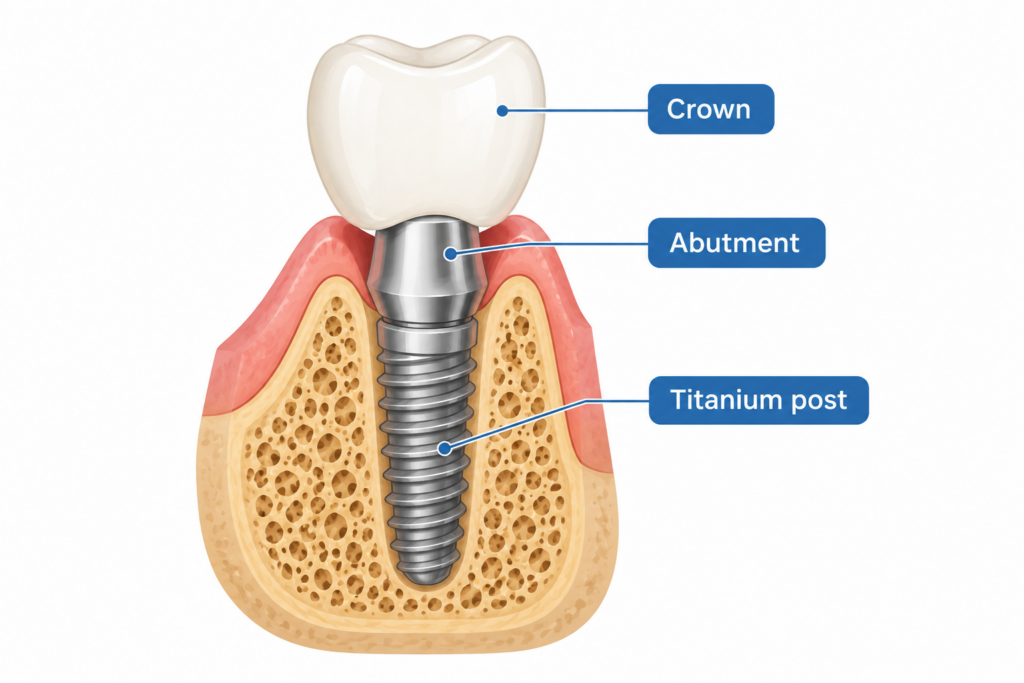
The first twelve months after placement are the period when the surrounding bone is settling into its final position. Marginal bone loss, the gradual loss of bone height right around the implant’s neck, is most active during this window and then typically slows down considerably⁵. Research following implants for up to ten years has shown that the height of the small connector piece between the implant and the crown, called the abutment, plays a measurable role here too. Implants restored with taller abutments lost significantly less marginal bone over time than those restored with short abutments⁵, which is one of several small technical decisions your dental team makes that can influence how the implant ages.
Oral hygiene and ongoing maintenance
None of the biological advantages of an implant matter much if plaque and bacteria are allowed to build up around it. Studies consistently link a history of gum disease, poor plaque control, and inconsistent maintenance visits with a higher rate of long-term complications³. The message from the research is consistent: an implant is not “finished” once it is placed and restored. It needs the same daily brushing, flossing or interdental cleaning, and periodic professional check-ups as your natural teeth, arguably more so, since the tissue around an implant respond to neglect somewhat differently to a natural tooth.
What “Failure” Actually Means
It helps to understand that implant problems tend to fall into two broad categories, based on timing.
Early failure happens before the crown or bridge is even placed, usually within the first few months after surgery. This is typically down to the implant not integrating properly with the jawbone, a process called osseointegration. Poor bone quality, uncontrolled systemic disease, smoking, infection, or a lack of primary stability at the time of placement are the most commonly cited causes⁴.
Late failure occurs after the implant has been restored and has been in function for a year or more, sometimes many years later. This is more often linked to ongoing biological or mechanical stress: excessive biting force, teeth grinding at night, peri-implantitis, or gradual loosening of the components holding the crown in place⁴.
Recognising which category a problem falls into is not something you need to diagnose yourself, but understanding the distinction helps explain why your dentist may ask different questions and take different action depending on when a concern arises.
The Warning Signs to Watch For
Because an implant does not have natural nerve tissue in the way a tooth does, changes around it can sometimes creep up quietly. Even so, there are consistent signs that something needs a professional look.
Persistent discomfort or a dull ache. Some tenderness in the days after surgery is normal, but pain that lingers, worsens, or returns after everything seemed to be healing well is worth reporting.
Swelling, redness, or bleeding gums around the implant. Gum tissue that looks or feels different from the tissue around your other teeth, particularly if it bleeds when you brush or floss, can be an early sign of inflammation.
A bad taste or persistent bad breath localised to the implant site. This can point to bacterial build-up in a pocket around the implant that is not being adequately cleaned.
Any looseness or movement of the implant or crown. A natural tooth has a small amount of give because of its ligament attachment to the bone. An implant should not move at all. Any mobility, however slight, needs urgent assessment, because once mobility is present it usually means the bone-to-implant connection has already been compromised⁴.
Difficulty chewing or a change in your bite. If the implant feels different when you bite down, or food seems to get caught around it in a new way, that is worth mentioning at your next visit rather than waiting.
Gum recession that exposes metal at the implant’s neck. This is more of a cosmetic and structural concern than an emergency, but it is still a sign that the surrounding tissue is changing and should be monitored.
Peri-implantitis, the inflammatory condition most commonly behind late implant failure, tends to develop gradually and can be difficult to notice in its earliest stages, in part because there is no aching nerve to alert you the way there would be with a natural tooth developing decay⁴. This is exactly why routine check-ups matter even when nothing feels obviously wrong. A dentist can measure the depth of the gum pocket around the implant and take radiographs to spot early bone loss long before it becomes something you would notice yourself.
What Happens If an Implant Does Fail
It is worth saying plainly that a failing implant is rarely a dead end. Catching problems early gives your dentist far more options, from non-surgical cleaning and decontamination of the implant surface, to more involved surgical treatment if bone loss has progressed further⁴. If an implant does need to be removed, replacement in the same site is often still possible once the area has healed, though survival rates for a second implant placed in a previously failed site tend to run somewhat lower than for a first attempt, which is one more reason early detection is worth taking seriously.
Getting the Most Years Out of Your Implant
Given everything above, a few habits make a genuine difference to how long an implant lasts.
Brush twice daily and clean between your teeth every day, using floss, interdental brushes, or a water flosser as your dentist recommends for your specific restoration. Keep up with your scheduled maintenance visits, even once the implant feels completely settled, since these are the visits where early bone changes are most likely to be caught. If you smoke, consider that quitting is one of the single most effective things you can do to protect an implant’s long-term survival. If you grind your teeth at night, ask about a protective night guard, since uncontrolled grinding places repeated mechanical stress on the implant and its components. Finally, keep your dentist informed about changes to your general health, particularly anything affecting blood sugar control or bone metabolism, so your maintenance plan can be adjusted accordingly.
A Realistic, Reassuring Picture
Put together, the long-term evidence paints a picture that should be reassuring rather than alarming. The large majority of dental implants remain functional for fifteen, twenty, or more years, and the factors that most strongly influence that outcome, smoking, glycaemic control, oral hygiene, and regular monitoring, are largely within your control or your dental team’s management. If you are considering an implant, or you already have one and want a second opinion on how it is doing, the team at DentMind CBD Dental Centre in Nairobi CBD can assess your implant, check for early signs of bone or gum changes, and talk you through a maintenance plan suited to your specific restoration. You can book an assessment through our online booking page or message us directly on WhatsApp.
Footnotes
¹ Kupka, J. R., König, J., Al-Nawas, B., Sagheb, K., & Schiegnitz, E. (2024). How far can we go? A 20-year meta-analysis of dental implant survival rates. Clinical Oral Investigations, 28(9), 541. https://doi.org/10.1007/s00784-024-05929-3
² French, D., Ofec, R., & Levin, L. (2021). Long term clinical performance of 10,871 dental implants with up to 22 years of follow-up: A cohort study in 4,247 patients. Clinical Implant Dentistry and Related Research, 23(3), 289–297. https://doi.org/10.1111/cid.12994
³ Adler, L., Buhlin, K., & Jansson, L. (2020). Survival and complications: A 9- to 15-year retrospective follow-up of dental implant therapy. Journal of Oral Rehabilitation, 47(1), 67–77. https://doi.org/10.1111/joor.12866
⁴ Kochar, S. P., Reche, A., & Paul, P. (2022). The etiology and management of dental implant failure: A review. Cureus, 14(10), e30455. https://doi.org/10.7759/cureus.30455
⁵ Galindo-Moreno, P., Catena, A., Pérez-Sayáns, M., Fernández-Barbero, J. E., O’Valle, F., & Padial-Molina, M. (2022). Early marginal bone loss around dental implants to define success in implant dentistry: A retrospective study. Clinical Implant Dentistry and Related Research, 24(5), 630–642. https://doi.org/10.1111/cid.13122
⁶ Chatzopoulos, G. S., & Wolff, L. F. (2023). Dental implant failure and factors associated with treatment outcome: A retrospective study. Journal of Stomatology, Oral and Maxillofacial Surgery, 124(2), 101314. https://doi.org/10.1016/j.jormas.2022.10.013