Losing one tooth is difficult enough. Losing most or all of the teeth in your upper or lower jaw changes how you eat, how you speak and often how you feel about smiling in public. For many years, a removable denture was the only answer. Today, All-on-4 dental implants and other implant-supported dentures give patients in Nairobi a far more stable way to replace a full arch of teeth.
This guide explains your options in plain language. We will look at how full-arch implant treatments work, what the research says about how long they last, and how to decide between a fixed bridge and a removable overdenture. Along the way, we will also be honest about the possible complications and the care these restorations need.
What Does “Replacing a Full Arch” Mean?
Your mouth has two arches: the upper jaw and the lower jaw. A full-arch restoration replaces all the teeth in one of these arches, or in both. Instead of each missing tooth getting its own implant, a small number of implants are placed in the jawbone and used as anchors for a complete set of replacement teeth.
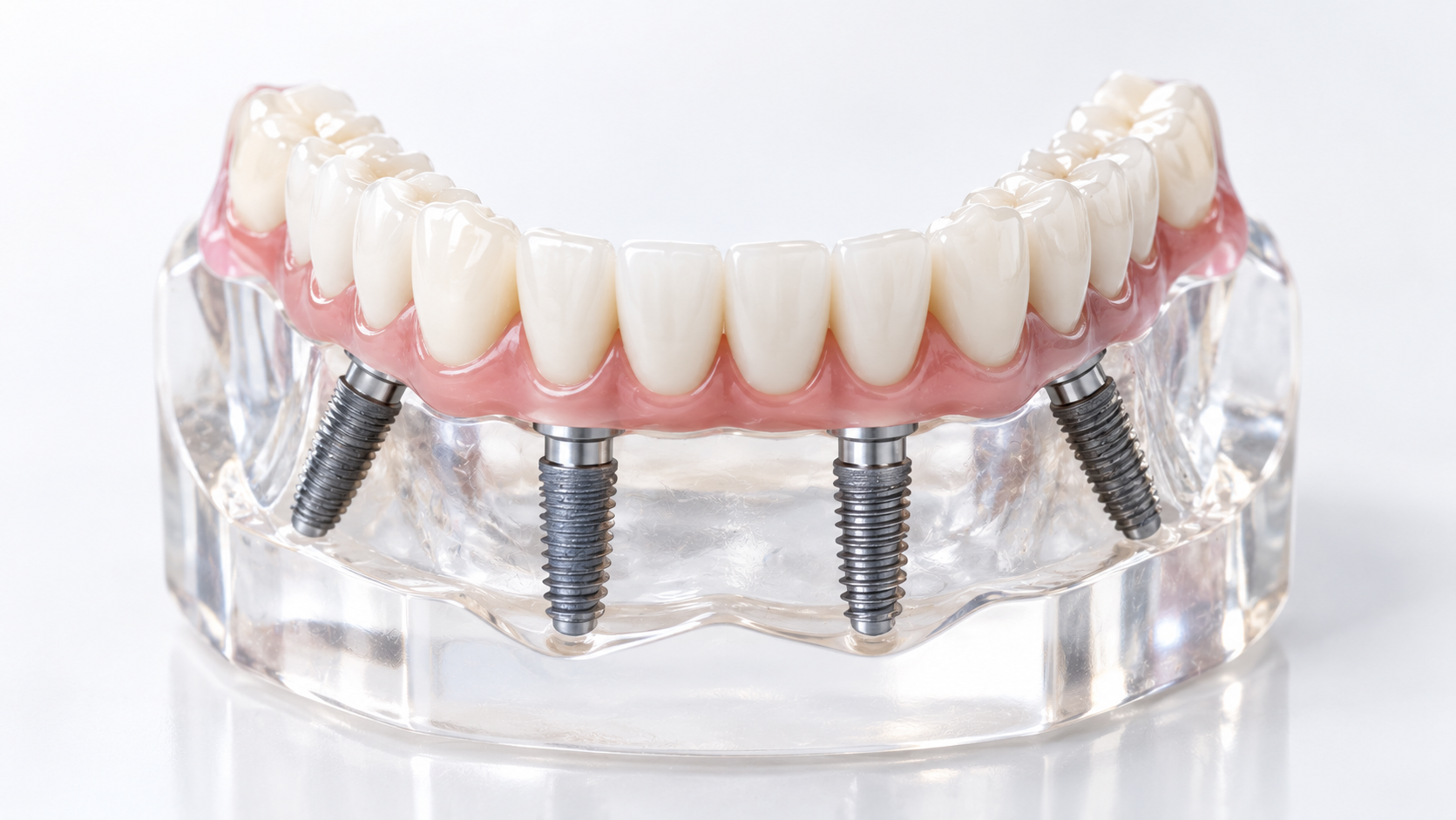
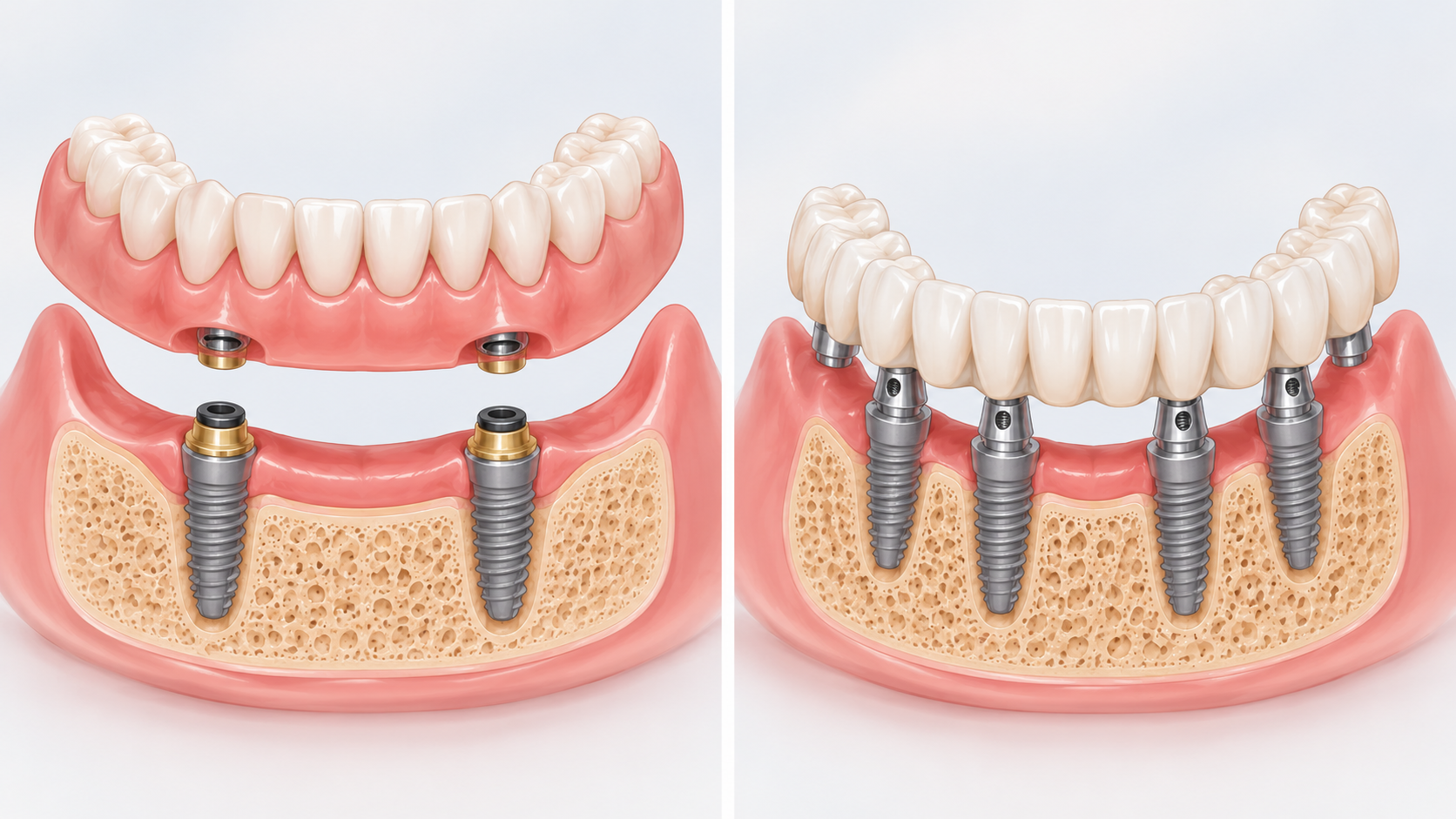
There are two broad ways to do this. The first is an implant-supported overdenture, which is a denture that clips firmly onto implants but can still be removed for cleaning. The second is a fixed full-arch bridge, which is screwed onto the implants and stays in your mouth permanently. All-on-4 is the best-known example of a fixed full-arch bridge.
Why Ordinary Dentures Can Be Hard to Live With
Conventional dentures rest on the gums and are held in place by suction, the shape of the jaw and, sometimes, adhesive. For some people they work well. However, many wearers find that dentures move when they eat or talk, rub on the gums or make certain foods hard to chew.
Over time, the jawbone in areas without teeth tends to shrink, so a denture that once fitted snugly can become loose. This is one reason why so many denture wearers look for a more secure option.
The evidence shows that implants make a real difference. A 2023 systematic review prepared for the International Team for Implantology consensus conference found that both fixed implant bridges and implant overdentures produced large improvements in how patients rated their oral health compared with ordinary dentures.¹ In other words, whichever implant option you choose, you are likely to notice a meaningful change.
Option 1: Implant-Supported Overdentures
An implant-supported overdenture looks similar to a normal denture. The difference is underneath. Small attachments on the denture clip onto two or more implants in the jaw, holding it firmly in place while you eat and speak.
How much better are they than ordinary dentures?
A 2021 systematic review compared lower dentures held by two implants with conventional lower dentures. Patients with the implant-retained version reported significantly higher overall satisfaction, along with better comfort, speech, chewing and stability.² However, the review found no clear advantage for appearance, and patients rated cleaning as slightly harder with the overdenture.²
The number of implants matters too. The 2023 review found that lower overdentures held by two implants gave patients noticeably better results than those held by just one.¹ For most people, two implants is the usual starting point for a lower overdenture.
Who might prefer an overdenture?
Because the denture comes out, it is easier to clean thoroughly. This can be a real advantage for people with limited hand movement, such as those with arthritis, or anyone who finds detailed cleaning around a fixed bridge difficult.¹ An overdenture can also be a good choice when there is limited bone, since it generally needs fewer implants than a fixed bridge.
Option 2: Fixed Full-Arch Bridges and All-on-4 Dental Implants
A fixed full-arch bridge is a complete row of teeth that is screwed securely onto implants. You do not take it out at home. Instead, your dentist removes it during professional maintenance visits when needed.
Patients often say a fixed bridge feels closer to having their own teeth again.¹ In the 2023 review, denture stability was the one area where fixed bridges scored significantly higher than overdentures.¹
How All-on-4 works
All-on-4 dental implants use four implants to support a full arch of teeth. Two implants are placed upright near the front of the jaw. The two at the back are placed at an angle, tilting backwards.
This angle is the clever part. Tilting the back implants allows them to be longer and to reach better-quality bone while avoiding important structures, such as the sinuses in the upper jaw and the nerve in the lower jaw. As a result, some patients who have lost bone at the back of the jaw can be treated without extensive bone grafting, although this always depends on the individual.
Can you get teeth on the same day?
In many cases, yes. With an immediate loading approach, a temporary fixed bridge is attached shortly after the implants are placed. The final bridge is then made once the implants have bonded with the bone. In one long-term study, the definitive bridge was fitted six months after surgery.³
Whether same-day teeth are suitable for you depends on the quality of your bone and how firmly the implants are held at the time of placement. Your dentist will explain this during planning. For a full picture of each stage, see our guide to the dental implant procedure step by step.
How Long Do All-on-4 Dental Implants Last?
This is the question most patients ask first about All-on-4 dental implants, and the long-term research is encouraging.
A study following 173 full-arch treatments (692 implants) using the All-on-4 style of two upright and two angled implants for 12 to 15 years found implant survival of about 97.5% in the upper jaw and 96.9% in the lower jaw at 15 years.³ Importantly, the angled back implants performed as well as the upright ones in the upper jaw.³
A second large study of 561 full-arch treatments, with follow-up of up to 17 years, reported implant survival of 97.4% in the upper jaw and 98.9% in the lower jaw.⁴ At the patient level, meaning whether a person kept their full-arch treatment working, survival was 94.4% for the upper jaw and 96.7% for the lower jaw.⁴
Finally, a 2026 umbrella review, which pulled together the findings of seven earlier systematic reviews, found that implants supporting full-arch bridges survived in 95.2% to 99.2% of cases. The bridges themselves survived in 89.5% to 96.8% of cases over 5 to 15 years.⁵
These figures are reassuring. Even so, they describe implants placed and maintained under good conditions, so your own care plays a big part. Our article on how long dental implants last and the signs of failure explains what affects longevity in more detail.
Four Implants or Six?
All-on-4 dental implants use four supports, while some full-arch bridges use five or six. Patients often wonder whether more implants means a stronger result.
A multicentre randomised clinical trial compared upper fixed bridges on four implants with those on six. After five years, implant survival was 100% in the four-implant group and 99.3% in the six-implant group, and the amount of bone around the implants was similar in both.⁶ No peri-implantitis occurred in either group during the study.⁶
There was one difference. The four-implant group had more technical complications, such as small repairs to the bridge, at 16.6% compared with none in the six-implant group.⁶ Similarly, the 2026 umbrella review found that using four or six implants did not significantly affect survival.⁵
In practice, the right number depends on your bone, your bite and which jaw is being treated. Your dentist will recommend what gives you the most secure long-term result.
Upper Jaw Versus Lower Jaw
Research consistently shows that the upper jaw is a little more demanding. In the 17-year study, implants in the upper jaw had a higher rate of early failure, and the upper jaw was the most significant risk factor for implant loss overall.⁴
The upper jaw usually has softer bone than the lower jaw, and the sinuses sit just above the back teeth. For this reason, some patients need extra planning or bone-building procedures before treatment. If this applies to you, our guide to bone grafting for dental implants explains what is involved.
Fixed or Removable: Which Is Right for You?
There is no single right answer, and the research supports both. The 2023 review found no statistically significant difference in the overall benefit patients reported from fixed bridges and overdentures.¹ So the decision usually comes down to your priorities and your mouth.
A fixed full-arch bridge, such as All-on-4 dental implants, may suit you if:
- You want teeth that stay in place and feel as close to natural teeth as possible.
- Maximum stability when eating and speaking matters most to you.
- You are comfortable with careful daily cleaning around the bridge and regular professional maintenance.
An implant-supported overdenture may suit you if:
- You would find it easier to remove your teeth for cleaning.
- You have limited hand movement or dexterity.
- You have less bone available, and fewer implants are preferable.
- You want a strong improvement on ordinary dentures with a simpler treatment.
Researchers also advise that a patient’s ability to clean their restoration should be reviewed over the years, since needs can change with age and health.¹ A good dentist will plan with your future in mind, not just the next few months.
What Can Go Wrong?
Full-arch treatment, including All-on-4 dental implants, is highly successful, but it is not completely free of problems. Being aware of them helps you know what to look out for.
According to the 2026 umbrella review, the most common issues were loosening of the screws that hold the bridge, chipping of the material covering the teeth, and, less often, fractures of the framework.⁵ Most of these are technical repairs rather than failures of the implants themselves.
The more serious concern is peri-implantitis, an infection of the gum and bone around the implants. The same review reported that it affected between 4% and 18% of patients across the studies it examined.⁵ Left untreated, it can lead to bone loss and, eventually, loss of implants.
The design and materials of the bridge also influence the type of problems that occur. The umbrella review found that bridges made from solid (monolithic) zirconia and screw-retained frameworks were linked with fewer technical complications.⁵ Your dentist can talk you through the materials suitable for your case.
Looking After Your New Teeth
A full-arch restoration is a long-term investment in your health, and its success depends on what happens after treatment as much as during it.
The European Federation of Periodontology’s clinical guideline recommends that implant restorations are designed so that patients can clean around them properly.⁷ It also recommends regular supportive care visits with a dental professional, tailored to each person’s risk, along with ongoing advice on home cleaning.⁷ In addition, the guideline stresses managing risk factors such as smoking and poorly controlled diabetes.⁷
In practical terms, this means:
- Cleaning carefully every day, using the brushes, floss or water flossers your dentist recommends for under and around your bridge.
- Removing and cleaning an overdenture daily, as advised.
- Attending your maintenance appointments, even when everything feels fine.
- Reporting any bleeding, swelling, looseness or a change in your bite promptly.
- Stopping smoking if you smoke. Our guide to smoking and dental implants explains why this matters so much.
For the first few weeks after surgery, our article on dental implant recovery and aftercare covers what to expect day by day.
Is Full-Arch Implant Treatment Right for You?
Most adults who have lost all or most of their teeth in a jaw can be considered for some form of implant-supported treatment. Your dentist will look at your general health, the amount and quality of bone you have, the condition of your gums and any remaining teeth, and your personal goals.
If you still have a few teeth left, you may also be weighing up other options. Our comparison of dental implants vs bridges and our guide on whether you are a good candidate for dental implants are useful starting points.
Missing teeth affect far more than appearance, touching how you eat, speak and feel in company. Whether you choose All-on-4 dental implants or a removable overdenture, the research shows that implant support can transform daily life compared with ordinary dentures. The best next step is a thorough assessment, so if you are ready to explore a fixed bridge, an overdenture or simply what is possible for your mouth, you can book an appointment online, chat with us on WhatsApp or visit DentMind CBD at Victor House, Kimathi Street, where our team will talk you through every option at your own pace.
For more on the global impact of tooth loss and oral disease, see the World Health Organization’s oral health fact sheet.
References
¹ Abou-Ayash, S., Fonseca, M., Pieralli, S., & Reissmann, D. R. (2023). Treatment effect of implant-supported fixed complete dentures and implant overdentures on patient-reported outcomes: A systematic review and meta-analysis. Clinical Oral Implants Research, 34(Suppl. 26), 177–195. https://doi.org/10.1111/clr.14065
² Egido Moreno, S., Ayuso Montero, R., Schemel Suárez, M., Valls Roca-Umbert, J., Izquierdo Gómez, K., & López López, J. (2021). Evaluation of the quality of life and satisfaction in patients using complete dentures versus mandibular overdentures. Systematic review and meta-analysis. Clinical and Experimental Dental Research, 7(2), 231–241. https://doi.org/10.1002/cre2.347
³ Agliardi, E., Pozzi, A., Romeo, D., & Del Fabbro, M. (2023). Clinical outcomes of full-arch immediate fixed prostheses supported by two axial and two tilted implants: A retrospective cohort study with 12–15 years of follow-up. Clinical Oral Implants Research. https://doi.org/10.1111/clr.14047
⁴ Uesugi, T., Shimoo, Y., Munakata, M., Sato, D., Yamaguchi, K., Fujimaki, M., Nakayama, K., Watanabe, T., & Malo, P. (2023). The All-on-four concept for fixed full-arch rehabilitation of the edentulous maxilla and mandible: A longitudinal study in Japanese patients with 3–17-year follow-up and analysis of risk factors for survival rate. International Journal of Implant Dentistry, 9(1). https://doi.org/10.1186/s40729-023-00511-0
⁵ Tomar, S., Agnihotri, N., & Vhanmane, G. (2026). Prosthetic complications of implant-supported complete arch prostheses: An umbrella review of systematic reviews. The Journal of Prosthetic Dentistry, 136(1), 52–59. https://doi.org/10.1016/j.prosdent.2026.03.013
⁶ Toia, M., Moreira, C. S., Dias, D. R., Corrà, E., Ravidà, A., & Cecchinato, D. (2025). Fixed full-arch maxillary prostheses supported by four versus six implants: 5-year results of a multicenter randomized clinical trial. Clinical Oral Implants Research. https://doi.org/10.1111/clr.14383
⁷ Herrera, D., Berglundh, T., Schwarz, F., Chapple, I., Jepsen, S., Sculean, A., Kebschull, M., Papapanou, P. N., Tonetti, M. S., Sanz, M., & EFP Workshop Participants and Methodological Consultants. (2023). Prevention and treatment of peri-implant diseases: The EFP S3 level clinical practice guideline. Journal of Clinical Periodontology, 50(Suppl. 26), 4–76. https://doi.org/10.1111/jcpe.13823