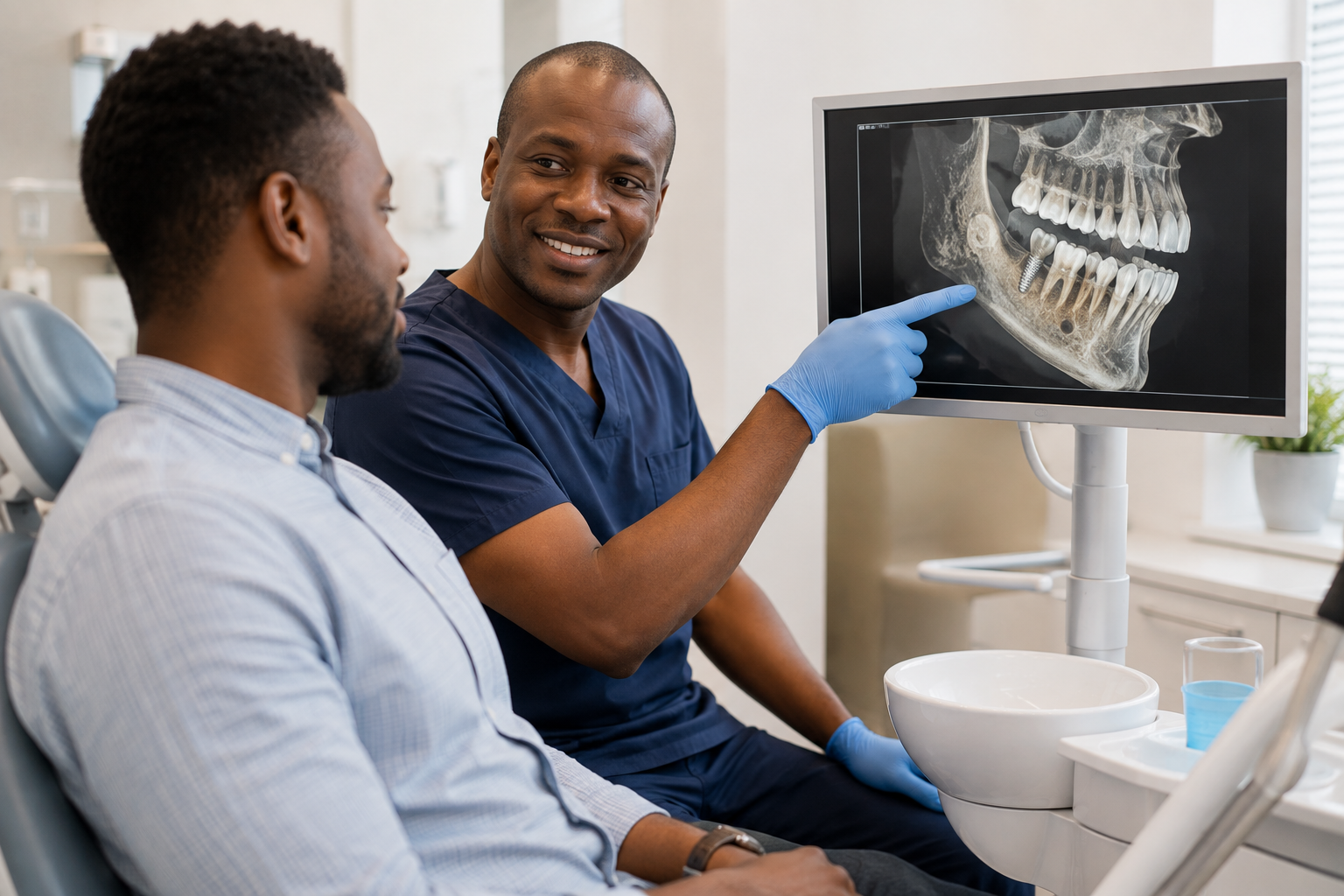
If you have decided to replace a missing tooth, the next natural question is what actually happens once you sit in the chair. The dental implant procedure can sound daunting when you have never been through it, yet each stage is planned carefully and carried out one step at a time. Knowing what to expect tends to make the whole experience feel far more manageable. This guide walks you through the dental implant procedure from your first consultation to the day your final crown is fitted, so you can arrive well informed and at ease.
What Is a Dental Implant?
A dental implant is a small titanium post that is placed into the jawbone to take the place of a missing tooth root. Over time the bone grows around it and holds it firmly in position. Once it has settled, a custom crown is attached on top, giving you a replacement tooth that looks and works much like a natural one.
Because the implant is anchored in the bone rather than resting on the gum, it offers stability that removable options cannot match. If you are still weighing your choices, it helps to read about how implants compare with a bridge before committing, since the two approaches suit different situations.
Before Your Dental Implant Procedure: Consultation and Planning
Every successful dental implant procedure begins long before any surgery takes place. The first appointment is all about assessment and planning, and it lays the groundwork for everything that follows.
During this visit, your dentist examines your mouth, reviews your medical history and checks the health of your gums and remaining teeth. A three dimensional scan, usually a cone beam CT, is then taken so the exact height, width and density of your jawbone can be measured. This scan matters because it shows precisely where the implant can sit and helps avoid nearby nerves and sinuses.
From these images, your treatment can be planned digitally before a single instrument is used. Modern computer guided planning has been shown to place implants very close to the intended position, with studies reporting an average deviation of just over one millimetre at the point of entry.1 In practical terms, that accuracy means a safer, more predictable result for you.
This stage is also when your dentist confirms whether you are a suitable candidate for implant treatment. Factors such as bone volume, gum health, smoking and certain medical conditions all play a part, and it is far better to address them now than midway through.
Step by Step: What Happens During the Dental Implant Procedure
Once your plan is agreed, the surgical part of the dental implant procedure can go ahead. It is usually carried out under local anaesthetic, which means the area is fully numb while you stay awake and comfortable throughout. Here is how a typical single implant unfolds.
Numbing the area. Your dentist first applies local anaesthetic so you feel no pain. You may notice pressure or movement, but not discomfort.
Preparing the site. If a tooth is still present, it is gently removed. The gum is then opened just enough to reach the bone, although in some cases a flapless technique keeps this to a minimum.
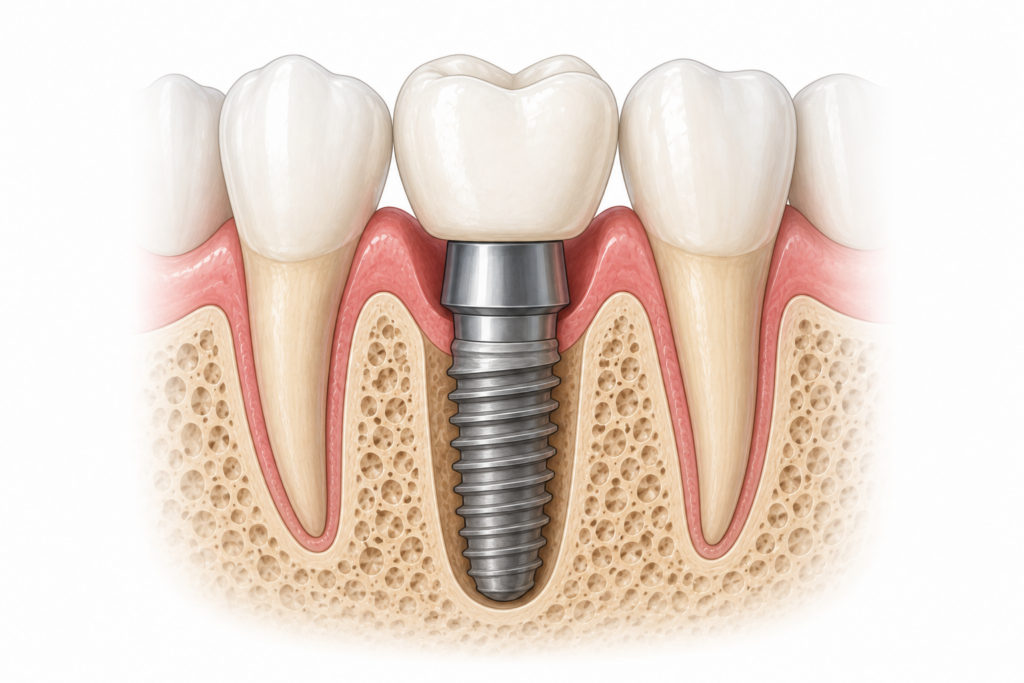
Placing the implant. A narrow channel is prepared in the bone using a series of precise drills. The titanium post is then eased into position and tightened until it is stable. This primary stability, the firm grip the bone has on the implant from day one, is an important sign that healing is off to a good start.
Closing up. Depending on your case, a small healing cap may be fitted, or the gum may be closed over the implant. A short set of stitches is often placed, and these either dissolve or are removed at a later visit.
The placement itself is often quicker than people imagine, frequently taking under an hour for a single implant. Larger cases naturally take longer, but the same careful sequence applies.
Healing and Osseointegration: How Your Implant Settles In
After placement, the most important work happens quietly beneath the surface. This phase is called osseointegration, and it is the process by which your jawbone fuses with the surface of the implant. It cannot be rushed, because it is what gives the implant its long term strength.
Healing usually takes several weeks to a few months, and the exact timing depends on your bone quality and where the implant sits. During this period, you follow simple guidance to keep the site clean and calm while the bone knits into place. Our full notes on recovery and aftercare cover this stage in detail, so it is well worth reading before your appointment.
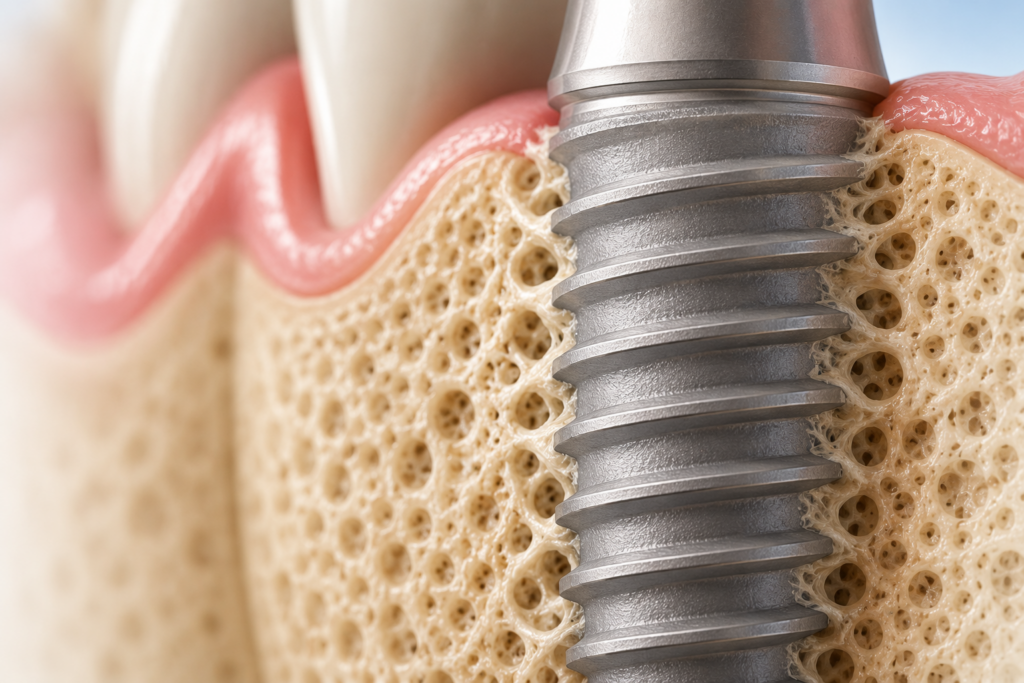
In some situations, a temporary tooth can be attached soon after placement rather than waiting for full healing, an approach known as immediate loading. Research comparing the different timings shows that survival rates remain high across the various protocols, although immediate loading does carry a slightly higher risk of early failure than the conventional wait and see approach.2 Your dentist will recommend the timing that gives you the safest result, and that decision is always tailored to your case.
Fitting the Abutment and Crown
Once osseointegration is complete and your dentist is satisfied the implant is secure, the restorative stage begins. This is the part that gives you your visible new tooth.
First, a small connector called an abutment is attached to the implant. This piece sits just above the gum line and links the implant below to the crown above. In some cases the abutment is placed at the same time as the implant, while in others it is added at a later visit.
Next, an impression or digital scan of your mouth is taken so that a crown can be made to match the shape and shade of your surrounding teeth. When it is ready, the crown is fitted onto the abutment and checked for a comfortable, even bite. At this point your treatment is essentially complete, and you can eat and smile with confidence.
How Long Do Dental Implants Last?
This is one of the most common questions patients ask, and the evidence is reassuring. Long term studies show that dental implants have very high survival rates over many years. One systematic review reported a ten year implant survival rate of around 96 per cent.3 Even over a twenty year span, the majority of implants continue to serve their purpose, which underlines just how durable a well cared for implant can be.4
That longevity, however, depends on good habits. Regular brushing, cleaning between the teeth and routine dental check ups all help protect your investment. Implants do not decay in the way natural teeth can, but the gum and bone around them still need care to stay healthy.
The Dental Implant Procedure at DentMind CBD Dental Centre
Understanding each stage of the dental implant procedure makes the journey far less intimidating, and it puts you in a stronger position to ask the right questions. From the first scan to the final crown, every step is designed to be safe, precise and comfortable, with plenty of time to heal properly along the way.
If you are ready to explore whether implants are right for you, our team at DentMind CBD Dental Centre in Nairobi CBD is here to guide you through it. You can book an appointment through our online portal, message us on WhatsApp or visit our website to learn more, and we are open every day of the week to fit around your schedule. Taking that first step is often the hardest part, and we are happy to make it a simple one.
No. The procedure is carried out under local anaesthetic, so the area is fully numb and you should not feel pain during placement. Mild soreness afterwards is normal and usually settles within a few days.
Placing a single implant often takes under an hour. The full journey, including healing, usually spans several weeks to a few months, because the bone needs time to fuse around the implant before the final crown is fitted.
With good care, implants last many years. Long term studies report survival rates of around 96 per cent at ten years, and the majority remain in place well beyond that.
Adequate bone volume and density help hold the implant securely. Your dentist checks this with a 3D scan during planning, and where bone is limited, options can be discussed at your consultation.
Treat it much like a natural tooth. Brush twice daily, clean between your teeth and attend regular check ups. Implants do not decay, but the surrounding gum and bone still need looking after.
FOOTNOTES
1 Khaohoen, A., Powcharoen, W., Sornsuwan, T., Chaijareenont, P., Rungsiyakull, C., & Rungsiyakull, P. (2024). Accuracy of implant placement with computer-aided static, dynamic, and robot-assisted surgery: A systematic review and meta-analysis of clinical trials. BMC Oral Health, 24, 359. https://doi.org/10.1186/s12903-024-04033-y
2 Chen, J., Cai, M., Yang, J., Aldhohrah, T., & Wang, Y. (2019). Immediate versus early or conventional loading dental implants with fixed prostheses: A systematic review and meta-analysis of randomized controlled clinical trials. The Journal of Prosthetic Dentistry, 122(6), 516–536. https://doi.org/10.1016/j.prosdent.2019.05.013
3 Howe, M.-S., Keys, W., & Richards, D. (2019). Long-term (10-year) dental implant survival: A systematic review and sensitivity meta-analysis. Journal of Dentistry, 84, 9–21. https://doi.org/10.1016/j.jdent.2019.03.008
4 Kupka, J. R., König, J., Al-Nawas, B., Sagheb, K., & Schiegnitz, E. (2024). How far can we go? A 20-year meta-analysis of dental implant survival rates. Clinical Oral Investigations, 28(10), 541. https://doi.org/10.1007/s00784-024-05929-3