Dental Abscess and Facial Swelling: When a Swollen Face Is a Dental Emergency
A dental abscess is one of the few dental problems that can turn from a nuisance into a genuine emergency within hours. When a pocket of infection at the root of a tooth or in the surrounding gum starts to spread, the face can swell, the jaw can stiffen, and in the worst cases breathing and swallowing become difficult. If you are in Nairobi CBD and your cheek, jaw or the area under your chin is swelling because of a bad tooth, this guide explains what is happening, which warning signs mean you should be seen straight away, and what to do while you make your way to a dentist.
What Is a Dental Abscess?
A dental abscess is a collection of pus caused by a bacterial infection. It usually begins when decay, a crack or a failed filling lets bacteria reach the soft inner part of the tooth, known as the pulp. From there the infection works its way down through the root and into the bone and soft tissue around it. An abscess can also start in the gum, particularly where gum disease has created deep pockets, or around a partly erupted wisdom tooth where bacteria become trapped.
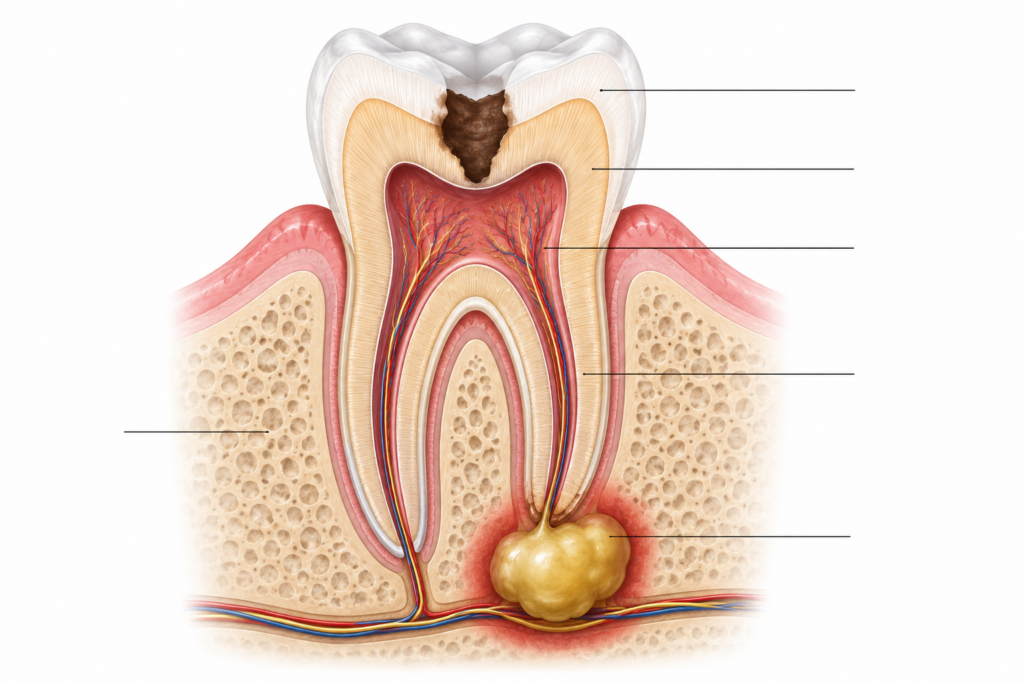
Research on pus samples taken directly from dental abscesses shows that these are polymicrobial infections, which means several different types of bacteria are usually involved at the same time.1 That mix matters, because it is part of the reason a single tablet bought over the counter rarely settles the problem for good.
The classic sign of a dental abscess is a deep, throbbing, relentless toothache, often in one clear spot, that can keep you awake at night. If you have already dealt with a toothache that keeps you up at night, you know how draining that can be. Some people also notice a bad taste as pus leaks out, tenderness when biting down, or a small pimple-like spot on the gum.
Why Facial Swelling Changes Everything
Pain on its own is miserable, but it is usually not dangerous. Swelling is different. When a dental abscess spreads beyond the tooth into the surrounding tissues, the cheek, jaw or neck can puff up. This is a sign that the infection is no longer contained, and it is the point at which a dental problem can quietly become a medical one.
The reason comes down to anatomy. The spaces around the jaw connect to the deeper spaces of the neck. If infection tracks into these spaces, it can start to press on the airway. A severe, spreading infection of the floor of the mouth, sometimes called Ludwig’s angina, can swell the tongue and neck to the point where breathing is threatened. Situations this serious are uncommon, but they are exactly why no one should try to wait out facial swelling that comes from a tooth.
Warning Signs That a Dental Abscess Is an Emergency
Not every swelling is a crisis, but some signs mean you should be seen without delay. Treat a dental abscess as an emergency if you notice any of the following:
- Swelling that is spreading quickly, or swelling that closes the eye or crosses to the other side of the face
- Difficulty swallowing, difficulty opening your mouth, or a change in your voice
- Any difficulty breathing, which needs emergency hospital care immediately
- A high fever, shivering, or a general feeling of being very unwell
- Swelling under the jaw or in the neck, or a firm, tender neck
- Fast-rising pain alongside the swelling

High-quality clinical evidence is clear that spreading infection, fever, swollen glands and diffuse swelling are precisely the situations where a dental infection needs urgent, hands-on treatment rather than watchful waiting.3 If breathing or swallowing is affected, that is a hospital emergency, not something to manage at home.
What to Do Right Now if Your Face Is Swelling
If the swelling is mild and you can still breathe and swallow comfortably, the priority is to get seen quickly and to stay comfortable in the meantime. Here is what helps:
- Contact a dentist as early in the day as you can. A spreading dental abscess needs draining and dental treatment, and the sooner that happens, the simpler it usually is.
- Keep your head raised, including when you sleep, to help limit the swelling.
- Take pain relief that you would normally use safely, such as paracetamol or ibuprofen if it suits you, following the instructions on the packet. Pain relief eases the discomfort, but it does not treat the infection.
- Rinse gently with warm salty water. This can soothe the gum and, in the case of a gum abscess that is already pointing, encourage it to drain. It is a comfort measure, not a cure.
- Keep drinking fluids and stay reachable by phone.
There are also things you should not do. Do not try to burst or squeeze the swelling yourself. Do not place an aspirin directly against the tooth or gum, because it burns the tissue rather than helping. Do not rely on leftover antibiotics from a previous illness or borrow them from a friend. And do not simply wait and hope if your face is visibly swelling.
If breathing or swallowing becomes difficult at any point, go straight to the nearest hospital emergency department.
Why Antibiotics Alone Will Not Cure a Dental Abscess
This is the part that surprises many people. Antibiotics feel like the obvious answer to an infection, but for a dental abscess they are only ever part of the picture, and quite often they are not needed at all once the tooth itself has been treated.
A Cochrane review, which sits at one of the highest levels of evidence in healthcare, examined whether antibiotics help adults with an acute apical abscess or a symptomatic infected tooth. It found that the first-line treatment should be removing the source of the infection through dental treatment, and that antibiotics are recommended only when there are clear signs of spreading infection or the person is unwell throughout the body.3 Put simply, the tablet does not fix the tooth. Draining the pus and then treating or removing the tooth is what actually resolves the problem.
A separate systematic review of the antibiotics used for acute dental infections reached a similar conclusion. The researchers found that no single antibiotic or regimen stood out as clearly best, and in one of the studies they reviewed, patients who received no antibiotics did just as well as those given broad-spectrum antibiotics, provided the dental cause was properly dealt with.2
There is also a real downside to taking antibiotics you do not need. Because the bacteria behind a dental abscess are so varied, overusing antibiotics encourages resistance, which makes infections harder to treat in future.1 This is why buying antibiotics over the counter and hoping the swelling fades is a poor and sometimes dangerous strategy. At best it does nothing about the tooth underneath. At worst it masks a spreading infection while the clock is ticking.
How a Dentist Treats a Dental Abscess
Treatment for a dental abscess is aimed at clearing the infection at its source and relieving the pressure. Depending on the tooth and how far the infection has travelled, a dentist may:
- Drain the abscess, releasing the trapped pus and easing both the pain and the swelling
- Carry out root canal treatment, which cleans the infection out of the inside of the tooth so that the tooth can be saved
- Remove the tooth if it cannot be saved, which also drains the infection
- Prescribe antibiotics as a support, but usually only where the infection is spreading or you are generally unwell
The clinic will also look at why the abscess happened in the first place, whether that is deep decay, a cracked tooth, gum disease or a troublesome wisdom tooth. If a wisdom tooth is the culprit, our guide on wisdom tooth removal in Nairobi CBD explains what to expect. Dealing with the underlying cause is what stops the problem returning. Where an extraction is involved, your dentist will also talk you through aftercare, including how to avoid complications such as dry socket.
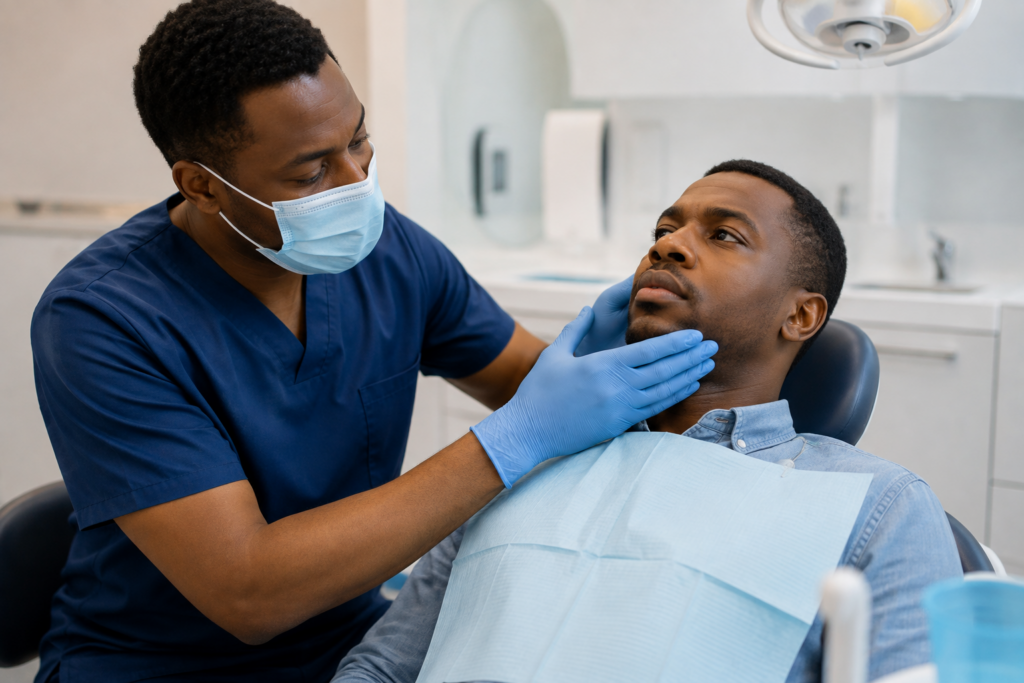
For anyone working or living in the city centre, a swollen face from a tooth is exactly the kind of problem our same-day emergency service is set up to handle.
How to Lower Your Risk of a Dental Abscess
Most dental abscesses trace back to problems that build up quietly over months or even years. You can lower your risk with a few consistent habits:
- Brush twice a day with fluoride toothpaste and clean between your teeth daily
- Attend regular check-ups so that decay and gum problems are caught before they reach the nerve
- Deal with a painful or sensitive tooth early rather than waiting for it to settle on its own
- Do not ignore a chipped or cracked tooth, since it gives bacteria an easy way in
- Keep any fillings, crowns and root-treated teeth under regular review
None of this guarantees you will never have a problem, but it dramatically reduces the odds of a small issue turning into a spreading infection.
A dental abscess is very treatable when it is caught early, and the outlook is good for people who are seen promptly. The real danger lies in waiting. So if your face is swelling because of a tooth, please do not sit it out and do not rely on a strip of tablets. Reach out to the team at DentMind CBD Dental Centre on Kimathi Street, send us a message on WhatsApp, find us on the map, or book straight away through our booking portal, and visit dentmindcbd.co.ke for more. And if you ever find it hard to breathe or swallow, treat it as the emergency it is and go to the nearest hospital at once.
FOOTNOTES
Place at the foot of the article under a small headin
1 Judith, M. J., Aswath, N., & Padmavathy, K. (2022). Microbiota of dental abscess and their susceptibility to empirical antibiotic therapy. Contemporary Clinical Dentistry, 13(4), 369–374. https://doi.org/10.4103/ccd.ccd_782_21
2 Teoh, L., Cheung, M. C., Dashper, S., James, R., & McCullough, M. J. (2021). Oral antibiotic for empirical management of acute dentoalveolar infections: A systematic review. Antibiotics, 10(3), 240. https://doi.org/10.3390/antibiotics10030240
3 Cope, A. L., Francis, N., Wood, F., Thompson, W., & Chestnutt, I. G. (2024). Systemic antibiotics for symptomatic apical periodontitis and acute apical abscess in adults. Cochrane Database of Systematic Reviews, 2024(5), CD010136. https://doi.org/10.1002/14651858.CD010136.pub4