Every parent wants their child to grow up with a bright, pain-free smile. One of the simplest ways to protect that smile is often overlooked, and it sits right on the dinner plate. A sensible diet for healthy teeth in children can stop cavities before they start, support strong enamel, and build habits that last a lifetime. At DentMind CBD Dental Centre here in Nairobi CBD, we see every week how much daily food choices shape a child’s oral health. This guide breaks down the foods that help, the ones that harm, and the small changes that make a genuine difference.
Why a Balanced Diet for Healthy Teeth in Children Matters
Tooth decay is the most common long-term disease of childhood. In fact, around half of preschool children in many countries already have at least one cavity.¹ Globally, early childhood caries affects roughly one in two young children, and the problem has been climbing rather than falling.² ³ These are not just baby-teeth problems either, because untreated decay can affect a child’s growth, weight, sleep, speech, and confidence.⁴
Decay does not happen because of one single thing. It develops when three factors line up at the same time: a vulnerable tooth, mouth bacteria, and a diet rich in fermentable sugars and starches.¹ Bacteria in dental plaque feed on those sugars and produce acid. That acid then dissolves the surface of the tooth, and over time a cavity forms. Because you cannot easily change your child’s teeth or their natural bacteria, diet becomes the factor you have the most power over.
Therefore, a good diet for healthy teeth in children is not about banning treats or chasing a perfect menu. It is about lowering how often the teeth are bathed in acid, and giving the mouth the nutrients it needs to repair itself. The rest of this guide shows you how.
Sugar: The Main Threat to Young Teeth
Sugar is the single biggest dietary cause of decay, and sucrose has earned the nickname “arch-criminal” among dentists.¹ It feeds the exact bacteria that damage enamel, and it helps sticky plaque cling to the tooth surface.
However, the amount of sugar is not the whole story. How often a child eats sugar matters more than how much they eat in one sitting.⁵ Each time sugar meets plaque, the mouth turns acidic for a stretch of time afterwards. As a result, a child who nibbles sweets throughout the day keeps their teeth under near-constant acid attack, while the same amount eaten quickly at one meal does far less harm.

Timing in the early years is important too. Children given sugar before twelve months of age had noticeably more cavities than those who waited until after two years.¹ For this reason, the World Health Organization advises keeping free sugars below ten percent of daily energy, and lower still for the very young.¹ Research also shows that children eating sugary snacks more than three times a day are roughly twice as likely to develop cavities.³
One more warning worth sharing: much of the sugar children eat is hidden. Fruit juices, flavoured yoghurts, breakfast cereals, sauces, and many packaged snacks carry more sugar than parents expect.⁶ Reading labels is one of the easiest wins for any family.
The Best Foods for a Diet for Healthy Teeth in Children
The good news is that plenty of everyday foods actively protect teeth. Building your child’s diet for healthy teeth in children around these choices makes prevention feel natural rather than restrictive.
Dairy foods are a strong starting point. Milk, cheese, and plain yoghurt supply calcium and phosphorus, the minerals that harden enamel and help repair early damage.⁵ ⁶ Cheese in particular makes an excellent snack, because it helps balance the acid in the mouth after eating.⁶
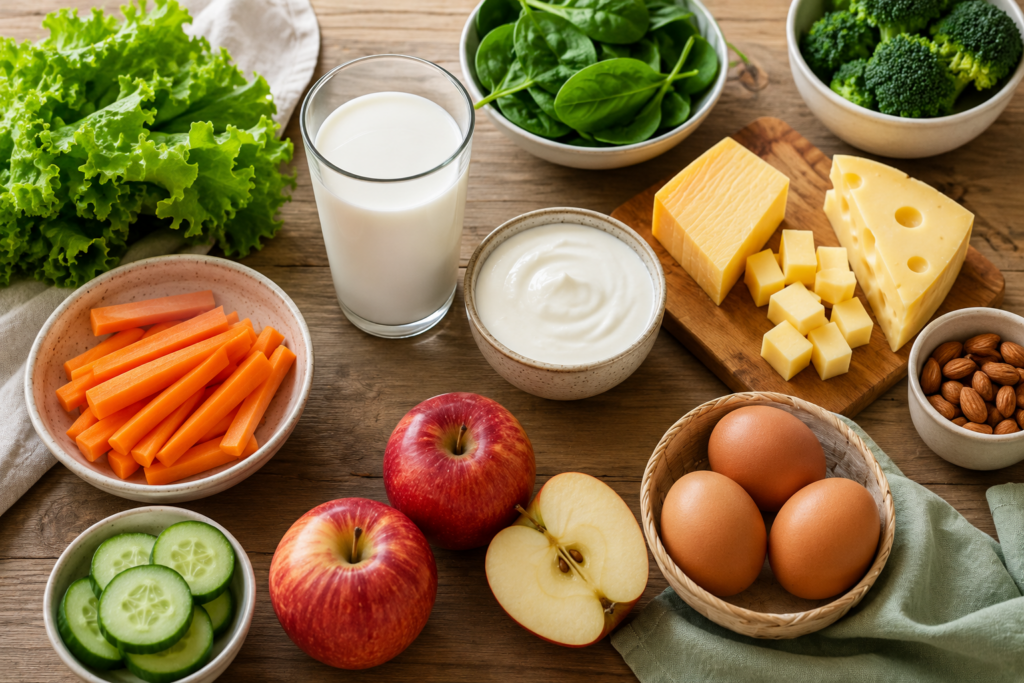
Crunchy fruit and vegetables also earn their place. Foods like carrots, apples, and celery need plenty of chewing, and chewing boosts saliva.⁵ Saliva is the mouth’s natural defence: it washes away food, neutralises acid, and carries minerals back to the teeth.⁶
Several vitamins and minerals matter for strong teeth and gums. A short list worth keeping in mind:
- Calcium and phosphorus protect and rebuild enamel. Find them in milk, cheese, yoghurt, eggs, fish, and leafy greens.⁵
- Vitamin D helps the body use calcium and supports enamel formation. Good sources include eggs, oily fish, and safe sunlight.⁵
- Vitamin C keeps gums healthy and helps them heal, and it is found in citrus, peppers, and many vegetables.⁵
- Vitamin A supports saliva production and enamel strength, and comes from carrots, spinach, and other orange and green vegetables.⁵
Finally, water deserves a special mention. It is the ideal drink for children between meals, because it rinses the mouth, carries no sugar, and keeps saliva flowing.³ ⁵
Drinks, Snacks, and Timing
What your child drinks can undo good food choices in seconds. Sugary sodas, cordials, and packaged juices are among the worst offenders, and they are best kept to a rare treat rather than a daily habit.³ For older children and teenagers, energy and sports drinks carry an extra danger, because they are both very sugary and highly acidic, with a pH low enough to erode enamel directly.⁵
Meanwhile, the timing of snacks matters as much as their content. When a child eats three regular meals, the teeth have time to recover between them, as the mouth swings back from acidic to neutral and minerals return to the enamel.⁵ Constant grazing removes those recovery periods. Because of this, we encourage families to keep sweeter foods to mealtimes, offer water or milk in between, and follow eating with a brush where possible.
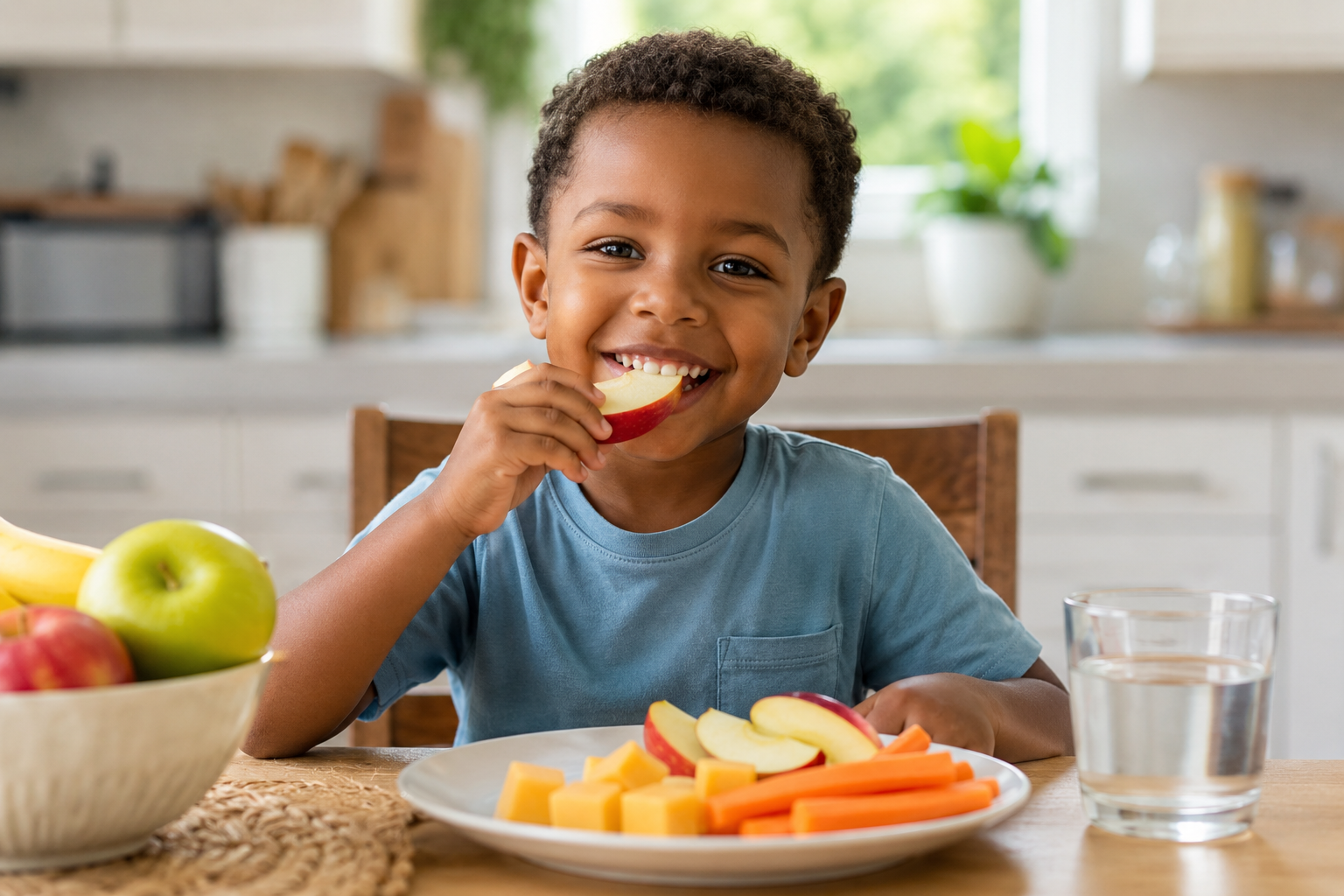
If your child does want a snack, reach for tooth-friendly options first. Cheese, plain yoghurt, crunchy vegetables, and fresh fruit all sit far better with healthy teeth than biscuits or sweets.⁶
Feeding Habits from the Very First Tooth
Good habits should begin long before a child can hold a spoon. Bottle feeding at bedtime is a well-known trigger for severe decay in babies, especially when the bottle contains milk sweetened with sugar, juice, or other sweet liquids.¹ The safest rule is simple: never settle a baby to sleep with a bottle of anything other than water.¹
Breastfeeding, by contrast, is linked with a lower risk of early cavities, which is one of many reasons health bodies recommend it. A 2024 meta-analysis confirmed this protective association across a large body of research.⁷ The World Health Organization advises exclusive breastfeeding for the first six months, after which healthy solid foods can be introduced.¹
Weaning time is another quiet turning point. Babies who start weaning foods at the right time, between four and six months, tend to have fewer cavities later than those whose weaning is delayed.¹ From that point, offering savoury and mineral-rich foods rather than sweet ones helps set a child’s taste for the years ahead. It also helps to skip sweetened dummies, which coat new teeth in sugar for long stretches.¹
Small Everyday Habits That Protect Teeth
Diet works best alongside a few simple routines. Together they form the backbone of any child’s dental care.
Brushing twice a day with a fluoride toothpaste is essential, and it should begin as soon as the first tooth appears.¹ Use only a smear of toothpaste for children under three, and a pea-sized amount for those aged three to six.¹ ⁶ Young children need a parent’s help until they can brush thoroughly on their own.
Sugar-free gum or snacks sweetened with xylitol or sorbitol can also help, because these sweeteners do not feed decay-causing bacteria the way ordinary sugar does.³ ⁶ They are a useful swap for older children who enjoy something sweet.

Regular dental visits complete the picture. We recommend a first check-up by around a child’s first birthday, then routine visits so problems are caught early.¹ Parents lead by example here, so brushing together and eating well as a family teaches more than any single lesson could.⁵
The 7 Everyday Food Rules at a Glance
- Make water the default drink between meals.
- Keep sugary treats to mealtimes, not spread through the day.
- Offer cheese, milk, or plain yoghurt daily for calcium.
- Choose crunchy fruit and vegetables for snacks.
- Never send a baby to bed with a sugary bottle.
- Read labels and watch for hidden sugars in juices and cereals.
- Pair good food with twice-daily brushing and regular check-ups.
Frequently Asked Questions
At what age should I start caring about my child’s diet for their teeth? From the very first tooth, and even before. Feeding habits in the first year, such as avoiding sugary bottles at bedtime and weaning at the right time, shape a child’s risk of decay for years to come.¹
Is fruit juice a healthy drink for my child’s teeth? Not really. Even natural juice is high in free sugars and acid, which can harm enamel when sipped often. Water and plain milk are far better everyday choices, with juice kept as an occasional treat at mealtimes.³ ⁶
Does cheese really help protect teeth? Yes. Cheese supplies calcium and phosphorus that strengthen enamel, and it helps balance acid in the mouth after eating, which makes it one of the better snack options for children.⁵ ⁶
My child eats healthily but still gets cavities. Why? Frequency and timing matter as much as the food itself. Constant grazing, hidden sugars, or missed brushing can all keep teeth under acid attack even with a good overall diet. A check-up can pinpoint the cause.⁵
How often should my child see a dentist? A first visit by around age one is ideal, followed by routine check-ups. Regular visits let us spot early decay, apply preventive care, and guide your child’s diet before small problems become painful ones.¹
Good food is the foundation, and a trusted dental team keeps that foundation strong. At DentMind CBD Dental Centre, our friendly approach to children’s dentistry helps young patients feel at ease while we protect their growing smiles. If you would like tailored advice on your child’s diet, or it is simply time for a check-up, our team in the heart of Nairobi CBD is here to help, and you can book a visit online in a couple of minutes.
DentMind CBD Dental Centre
Victor House, Third Floor, Kimathi Street, Nairobi CBD
Phone: 0715 063640
Website: dentmindcbd.co.ke
Online bookings: recordit.ke
Open Monday to Sunday
FOOTNOTES
¹ Patel, N. S., Mehta, M., Fu, Y., Desai, V., Lala, H. S., Parikh, H., Patel, M. M., & Thakor, U. B. (2025). A review of early childhood caries: Risk factors, management, and policy recommendations. Cureus, 17(5), e83767. https://doi.org/10.7759/cureus.83767
² Maklennan, A., Borg-Bartolo, R., Wierichs, R. J., Esteves-Oliveira, M., & Campus, G. (2024), as cited in Patel et al. (2025). A systematic review and meta-analysis on early-childhood-caries global data. BMC Oral Health, 24, 835. https://doi.org/10.1186/s12903-024-04605-y
³ Han, S.-Y., Chang, C.-L., Wang, Y.-L., Wang, C.-S., Lee, W.-J., Vo, T. T. T., Chen, Y.-L., Cheng, C.-Y., & Lee, I.-T. (2025). A narrative review on advancing pediatric oral health: Comprehensive strategies for the prevention and management of dental challenges in children. Children, 12(3), 286. https://doi.org/10.3390/children12030286
⁴ Sheiham, A. (2006), as cited in Han et al. (2025). Dental caries affects body weight, growth and quality of life in pre-school children. British Dental Journal, 201, 625–626. https://doi.org/10.1038/sj.bdj.4814259
⁵ Dimopoulou, M., Antoniadou, M., Amargianitakis, M., Gortzi, O., Androutsos, O., & Varzakas, T. (2023). Nutritional factors associated with dental caries across the lifespan: A review. Applied Sciences, 13(24), 13254. https://doi.org/10.3390/app132413254
⁶ Butera, A., Maiorani, C., Morandini, A., Simonini, M., Morittu, S., Trombini, J., & Scribante, A. (2022). Evaluation of children caries risk factors: A narrative review of nutritional aspects, oral hygiene habits, and bacterial alterations. Children, 9(2), 262. https://doi.org/10.3390/children9020262
⁷ Shrestha, S. K., Arora, A., Manohar, N., Ekanayake, K., & Foster, J. (2024). Association of breastfeeding and early childhood caries: A systematic review and meta-analysis. Nutrients, 16(9), 1355. https://doi.org/10.3390/nu16091355