
When a crown fell off or a filling came out, most people notice it in the middle of a meal. You bite down on something, feel a hard piece in your mouth that is not food, and your tongue finds a gap or a rough edge where your tooth used to feel smooth. It is unsettling, and it often comes with a sudden twinge of sensitivity.
The reassuring news is that a lost filling or loose crown is rarely a true emergency. In most cases, you can protect the tooth at home for a day or two until you see a dentist. However, what you do in those first hours matters, both for your comfort and for whether the crown can be reused.
This guide explains why fillings and crowns come out, what to do with a crown that has come off, how to protect the exposed tooth, what you should never try, and when you need to be seen straight away.
Is a Lost Filling or Crown an Emergency?
Usually, no. A lost filling or a crown that has come off needs attention soon, but it does not normally need a hospital or a late-night dash across town.
Even so, it should not be left for weeks. The tooth underneath is now exposed. It is weaker, more sensitive and more vulnerable to decay and breakage than before. Food and bacteria can also collect in the gap, which can lead to further damage or infection.
As a general rule, try to see a dentist within a few days. You should be seen sooner if you have severe pain, swelling, a sharp edge cutting your tongue, or the tooth itself has broken. Those warning signs are covered later in this guide.
Why Fillings and Crowns Come Out
It is natural to wonder whether you did something wrong. Usually, you did not. Fillings and crowns do not last forever, and several factors affect how long they stay in place.
Why Fillings Fail
A detailed review of how long fillings last found that the two most common reasons fillings fail are new decay forming around the edges of the filling, known as secondary decay, and fracture of the filling or the tooth.¹
Importantly, the same review showed that the filling material is only part of the story. Patient factors play a major role, including a high risk of tooth decay and habits such as grinding or clenching the teeth.¹ In other words, how a mouth is used and cared for affects how long its fillings last.
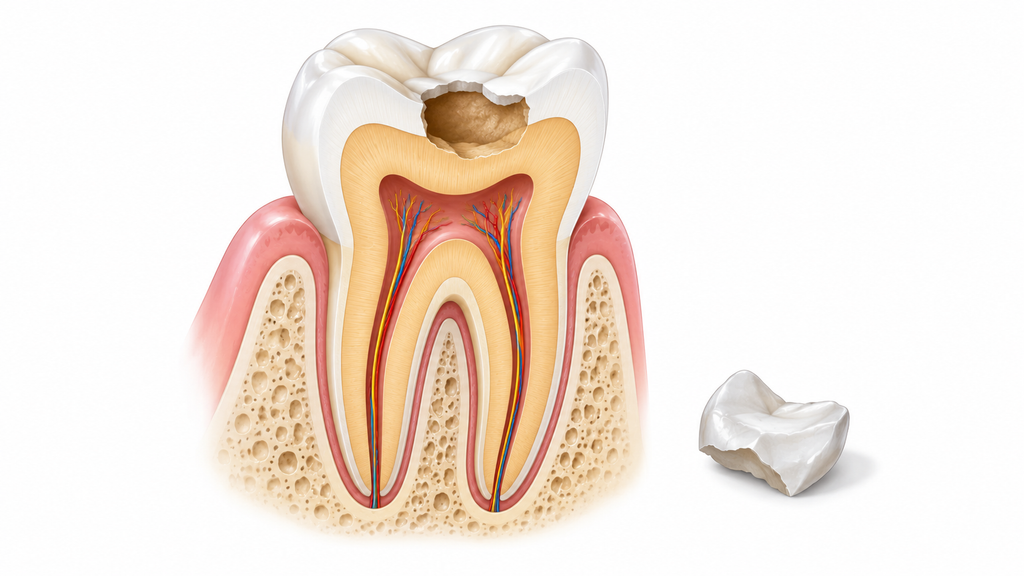
Common triggers that can finally dislodge a weakened filling include:
- Biting on hard foods such as bones, nuts, hard sweets or ice
- Chewing sticky foods such as toffee or chewing gum
- Grinding or clenching your teeth, especially at night
- Decay that has quietly undermined the filling from underneath
- Simple age and wear of an older filling
Why Crowns Come Off
A crown is a cap that covers the whole visible part of a tooth and is held in place with dental cement. Over time, that cement can wash out, or decay can develop underneath the crown edge and loosen it.
Interestingly, crowns coming off completely is not the most common way they fail. A systematic review of 52 studies on zirconia crowns found that chipping or fracture of the porcelain layer was about four times more likely than the crown losing its grip on the tooth.² So if your crown has come off in one piece, that is often good news, because it may be possible to clean it and fix it back in place.
What to Do Straight Away
Whether it is a filling or a crown, start with these simple steps.
- Stop eating and remove the piece from your mouth carefully.
- Rinse your mouth gently with warm water to clear away food debris.
- Look at the tooth in a mirror if you can, and check for sharp edges, bleeding or a broken tooth.
- Keep the piece. Put the crown or any large filling fragment in a small clean container or bag and bring it to your appointment.
- Book an appointment and tell the clinic exactly what happened, so the team can plan enough time.
If Your Crown Fell Off
A crown that has come off in one piece can often be cleaned and recemented, which may save you the time and expense of a new one. Here is how to look after it.
- Keep it safe and dry in a small container. Do not wrap it in tissue, which is easily thrown away by mistake.
- Clean it gently by rinsing it under cool water. Do not scrub it hard or soak it in bleach or other chemicals.
- Check inside the crown. If you can see a piece of tooth inside it, the tooth may have broken rather than the cement failing. Bring it in either way.
- Do not try to force it back on if it does not fit easily. Pushing hard can crack the crown or damage the tooth.
Should You Put the Crown Back On Yourself?
Pharmacies sometimes sell temporary dental cement kits. If you cannot see a dentist for several days and the crown fits easily and comfortably, some people use these as a short-term measure.
If you do, follow the packet instructions carefully and check that the crown sits in the right position, with your bite feeling normal when you close your teeth. Remember that this is only a temporary fix. Your dentist will still need to remove the temporary material, check the tooth and fix the crown properly.
However, if you are not confident, the crown feels loose or the bite feels wrong, it is safer to keep the crown in its container and wait for your appointment.
Never Use Household Glue
Do not use superglue or any household adhesive to reattach a crown or filling. These products are not made for use in the mouth. They can irritate the gum, trap bacteria underneath the crown and make it far harder for a dentist to clean and refit the crown properly later.
If You Lost a Filling
If you have lost a filling, there is no piece to put back. Instead, the aim is to keep the tooth clean, comfortable and protected until you are seen.
- Keep brushing gently around the tooth with a soft toothbrush, so food and plaque do not build up in the hole.
- Rinse with warm salt water after meals to clear trapped food.
- Chew on the other side of your mouth.
- Consider a temporary filling material from a pharmacy if the hole is large, sharp or trapping food, and follow the packet instructions.
- Cover a sharp edge with a small piece of sugar-free gum or dental wax if it is cutting your tongue or cheek.
Managing Sensitivity and Pain
Once a filling or crown is gone, the tooth underneath may feel sensitive to cold drinks, hot food, sweet things or even air. This is because the inner layer of the tooth, called dentine, is now exposed.
To ease sensitivity:
- Avoid very hot, very cold and very sweet food and drinks for now.
- Use a toothpaste for sensitive teeth, and dab a small amount over the area before bed.
- Breathe through your nose if cold air triggers sensitivity.
If the tooth is painful, over-the-counter painkillers can help. Evidence-based guidance from the American Dental Association recommends anti-inflammatory painkillers such as ibuprofen, alone or together with paracetamol, as the first choice for short-term dental pain.³ Always follow the packet or pharmacist’s instructions, and check with a professional if you have stomach problems, asthma, kidney problems, are pregnant, or take other medicines.
Never place aspirin or any tablet directly on the gum or tooth, as this can burn the soft tissue.
What If You Swallowed the Crown or Filling?
This happens more often than you might think, especially when a crown comes off while eating. In most cases, swallowing a crown or a small piece of filling is not dangerous.
A study of accidents involving dental objects found that crowns and bridges were the items most often swallowed or inhaled. About 95% of the objects were swallowed into the stomach and passed without major problems, while around 5% were inhaled into the airway and needed removal in hospital.⁴
That study looked at accidents in a dental clinic rather than at home, but the pattern is a useful guide:
- If you swallowed the piece and feel completely well, with no coughing or breathing difficulty, it will usually pass naturally. Tell your dentist, as the crown will then need replacing.
- If you started coughing, choking or wheezing when it happened, or you now have chest discomfort or difficulty breathing, it may have gone into your airway. Go to the nearest hospital emergency department immediately.
Red Flags: When You Need to Be Seen Urgently
Most lost fillings and crowns can wait a day or two. The following cannot:
- Severe or throbbing pain that painkillers do not control, or pain that keeps you awake at night.
- Swelling of the gum or face, a bad taste, pus or fever, which may signal infection.
- A broken tooth, especially if a large part of it has come away with the crown or filling. Our guide to what to do about a broken tooth explains more.
- A sharp edge that is cutting your tongue or cheek and cannot be covered.
- Possible inhalation of the crown or filling, as described above.
If pain flares up after hours, our article on toothache at night in Nairobi CBD has practical tips for getting through until morning.
What Happens at Your Appointment
When you arrive, the dentist will examine the tooth and, if needed, take an X-ray to check for decay or damage underneath. What happens next depends on what they find.
Recementing the Crown
If the crown is intact, fits well and the tooth underneath is healthy, the dentist can clean both surfaces and cement the crown back in place. This is often the quickest and simplest outcome, which is why keeping the crown safe matters.
Replacing the Filling
For a lost filling, the dentist will remove any decay, clean the cavity and place a new filling. If the tooth has become weak, they may suggest a stronger option such as an onlay or a crown to protect it.
A New Crown or Further Treatment
If the crown is damaged or no longer fits, or the tooth underneath has decayed or broken, a new crown may be needed. In some cases, where decay has reached the nerve of the tooth, root canal treatment may be recommended before the tooth is restored. Your dentist will explain the options clearly before starting.
How to Stop It Happening Again
You cannot prevent every lost filling or loose crown, but a few habits help them last much longer:
- Avoid biting hard objects such as bones, ice, bottle tops, pens and fingernails.
- Limit sticky sweets and chewing gum, especially on teeth with large fillings or crowns.
- Brush twice a day with fluoride toothpaste and clean between your teeth, paying extra attention to the edges of crowns and fillings where decay often starts.
- Cut down on sugary snacks and drinks between meals to lower your risk of new decay.
- Ask about a night guard if you grind or clench your teeth.
- Keep up regular check-ups, so your dentist can spot worn or leaking fillings and crowns before they fail.
Final Word on a Crown That Fell Off or a Lost Filling
A lost filling or a crown that has come off is a nuisance, but it is usually straightforward to fix when you act within a few days. Keep the crown safe, keep the tooth clean, ease any sensitivity, avoid household glue, and watch for the warning signs that mean you need to be seen sooner. If you have lost a filling in Nairobi or your crown fell off, the team at DentMind CBD Dental Centre on Kimathi Street can see you promptly to protect the tooth and restore it properly. You can book online, message us on WhatsApp or call 0715 063640, and you can read more about our emergency dental care in Nairobi CBD before you visit.
For general background on crowns and how they are fitted, see the National Institute of Health guide to dental crowns.
This article is for general information and DOES NOT REPLACE a professional dental or medical assessment. If you think you may have inhaled a crown or filling, or you have any difficulty breathing, go to the nearest hospital emergency department immediately.
References
¹ Demarco, F. F., Cenci, M. S., Montagner, A. F., de Lima, V. P., Correa, M. B., Moraes, R. R., & Opdam, N. J. M. (2023). Longevity of composite restorations is definitely not only about materials. Dental Materials, 39(1), 1-12. https://doi.org/10.1016/j.dental.2022.11.009
² Gonzaga, C. C., Garcia, P. P., Wambier, L. M., Prochnow, F. H. O., Madeira, L., & Cesar, P. F. (2022). Do tooth-supported zirconia restorations present more technical failures related to fracture or loss of retention? Systematic review and meta-analysis. Clinical Oral Investigations, 26(8), 5129-5142. https://doi.org/10.1007/s00784-022-04573-z
³ Green, V. G., Polk, D. E., Turturro, M. A., Moore, P. A., & Carrasco-Labra, A. (2025). Evidence-based clinical practice guidelines for the management of acute dental pain. American Journal of Emergency Medicine, 89, 247-253. https://doi.org/10.1016/j.ajem.2024.12.054
⁴ Huh, J., Lee, N., Kim, K.-Y., Jung, S., Cha, J., Kim, K.-D., & Park, W. (2022). Foreign body aspiration and ingestion in dental clinic: A seven-year retrospective study. Journal of Dental Anesthesia and Pain Medicine, 22(3), 187-195. https://doi.org/10.17245/jdapm.2022.22.3.187