How Sugar Destroys Your Teeth: The Science Behind Every Soda, Sweet, and Snack
You already know sugar is not great for your teeth. Every dentist, every parent, and every primary school health lesson has said so. But knowing a thing and understanding it are very different. Once you understand exactly what sugar does inside your mouth, the habit of reaching for a soda or a packet of biscuits between meals starts to look very different.
This is not about guilt. It is about giving you the kind of clear, research-backed information that helps you make real decisions for your oral health and the health of your family. The science here draws on peer-reviewed research published in leading journals, and the story turns out to be more fascinating, and more serious, than most people realise.
A Question Dentists Have Asked Since 1858
The relationship between sugar and tooth decay is not new. As far back as 1858, a dentist writing in the Dental Register noted that sugar, by itself, does not corrode tooth enamel directly. What it does, he observed, is feed the fermentation of other substances around the teeth, which produces acid, and that acid is the real agent of destruction. In his words, sugar “promotes the fermentation of other vegetable substances which may be about, and especially between teeth, the acetic acid which would thus be formed, would prove an active source of decay.”¹
That observation, made over 160 years ago, turns out to be essentially correct. What modern science has done is fill in the extraordinary detail of exactly how that process unfolds, why some people are more vulnerable than others, and why the problem goes far beyond cavities.
What Actually Happens When Sugar Enters Your Mouth
Your mouth is not a passive cavity. It is a living ecosystem of approximately 700 species of bacteria, constantly interacting with each other, with your saliva, and with what you eat and drink.²
In a healthy mouth, this ecosystem is balanced. Bacteria that produce acid coexist with bacteria that neutralise it. Your saliva buffers pH changes and deposits minerals back into tooth enamel in a constant process of repair. The system is remarkably resilient.
Sugar disrupts that balance at every level.
Step One: The Acid Attack

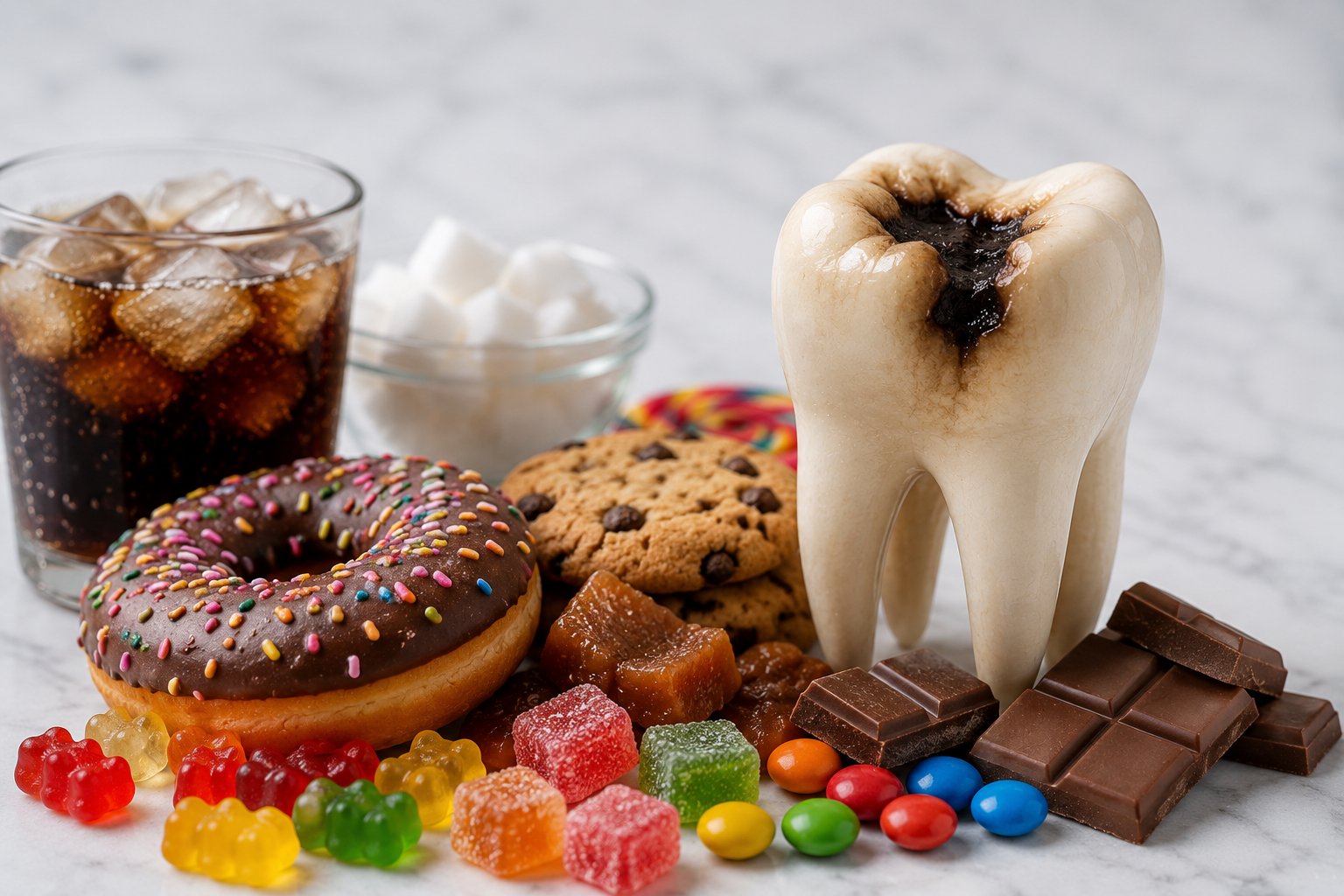
When you consume sugar, the bacteria in your dental plaque metabolise it almost immediately. Certain species, most notably Streptococcus mutans, are particularly efficient at this. They ferment sugars and produce lactic acid as a byproduct. That acid drops the pH of your plaque, sometimes within minutes of eating or drinking something sweet.²
When pH falls below 5.5, the critical threshold for enamel demineralization, the mineral content of your tooth surface begins to dissolve. This is not metaphorical. The hydroxyapatite crystals that give your enamel its hardness literally begin to break down.
Your saliva will eventually re-mineralise the enamel if given enough time. The problem is frequency. A single sugary snack gives your mouth roughly 20 to 30 minutes of acid exposure before pH recovers. If you are sipping sweet tea throughout the morning, eating biscuits mid-afternoon, and finishing with a fruit juice in the evening, your enamel is spending most of the day under acid attack and almost no time rebuilding.
Step Two: The Microbiome Shifts Against You

This is where the science becomes genuinely sobering.
Spatafora et al. (2024), reviewing the microbiology of dental caries in Microorganisms, describe what happens to the oral microbiome under sustained sugar stress.² Initially, the community responds to acid by allowing acid-tolerant species to proliferate. S. mutans, lactobacilli, Bifidobacterium, and Scardovia species begin to dominate. The species that normally buffer acid and keep the environment healthy are suppressed because they cannot survive at low pH.
Once S. mutans colonises the dentition, it does something particularly clever. It converts sucrose into extracellular polysaccharides that form a sticky, protective matrix around itself and other bacteria. This matrix traps lactic acid directly against the tooth surface, concentrating the damage. It also makes the biofilm dramatically harder to remove by brushing.
The result is a self-reinforcing cycle. Sugar feeds the bacteria. The bacteria produce acid. The acid kills off the competing healthy bacteria. The remaining bacteria become more aggressive. The enamel dissolves faster.
By the time a cavity becomes visible, this process has often been running for months or years.
Beyond Cavities: Sugar, Inflammation, and Your Gums
Most people think of sugar damage in terms of cavities. The research tells a more expansive story.
Shanmugasundaram and Karmakar (2024), in a narrative review published in BDJ Open, synthesise evidence showing that excess dietary sugar, particularly fructose and sucrose, drives low-grade systemic inflammation through several distinct pathways.³
When you consume large amounts of fructose, it is metabolised in the liver. This process generates metabolites, including uric acid and lactate, that activate inflammatory pathways throughout the body. The NF-κB pathway is triggered. Pro-inflammatory cytokines including IL-1β, TNF-α, and IL-6 are elevated in circulation. The gut barrier becomes more permeable, allowing bacterial endotoxins to enter the bloodstream and amplify the inflammatory response.³
Why does this matter for your teeth? Because periodontitis, the disease that destroys the bone and tissue supporting your teeth, is fundamentally an inflammatory condition. The authors note that excess dietary sugar can negatively influence all three of the critical factors in periodontal disease progression: it disrupts the oral microbiota to cause dysbiosis, drives systemic inflammation that aggravates gum tissue, and contributes to metabolic risk factors like obesity and type 2 diabetes that are independently linked to worse periodontal outcomes.³
A systematic review cited in that paper concluded that restricting free-sugar intake reduces gingival inflammation. Another found that sugar-sweetened beverage consumption increases the risk of periodontal disease. These are not theoretical associations. The evidence points to a direct, biological pathway from what you eat to the health of your gums.
The WHO’s Global Oral Health Status Report of 2022 puts the scale of this in perspective: severe periodontitis affects around one billion people worldwide, and dietary sugars are identified as a key modifiable risk factor.³
The Microbiome Evidence: Why Frequency Matters More Than Quantity
One of the most important insights from the dental microbiome research is that how often you consume sugar may matter more than how much you consume in total.
The ecological plaque hypothesis, described in detail by Spatafora et al. (2024), explains this.² Under normal conditions, the oral microbiome can recover from acid challenges. If you eat something sweet and then give your mouth an hour without further sugar, pH recovers, healthy bacteria re-establish themselves, and remineralisation can occur.
But if sugar arrives frequently, sometimes with every sip of a sweetened drink, the microbiome never gets the chance to rebalance. The acid-tolerant, caries-associated bacteria are continuously advantaged. Over time, this persistent acidic environment becomes the new normal for your oral ecosystem, and the shift from health to disease can become very difficult to reverse without professional intervention.
Research conducted during World War II provided some of the most striking historical evidence for this. In multiple European countries where sugar rationing drastically reduced intake, caries rates fell significantly. When sugar became available again after the war, rates rose back to pre-war levels within a short period. The pattern was so consistent across different countries and populations that it became one of the foundational pieces of evidence linking sugar to tooth decay.²
The Sugar You Are Not Thinking About
When people hear about sugar and teeth, they think of sweets and soda. The reality is more complicated.
White rice, bread, crackers, and other refined starches are rapidly broken down by salivary amylase in the mouth to simple sugars. They feed S. mutans just as readily as a spoonful of sugar. Sweetened yoghurt, energy drinks marketed as healthy, flavoured water, bottled fruit juices, and many breakfast cereals contain levels of free sugar that exceed WHO recommended limits in a single serving.
The WHO recommends limiting free sugars to less than 10% of total energy intake, with additional benefits from reducing below 5%. The American Heart Association recommends less than 36 grams of added sugar per day for men and less than 25 grams for women.³ To put that in context, a single 500ml bottle of regular soda contains around 52 grams of sugar, already exceeding either limit before any other food has been consumed.
In Kenya, as elsewhere, urbanisation has brought a rapid shift toward processed and ultra-processed foods. The pattern of tooth decay in populations that make this transition quickly is well documented and alarming. Crubézy et al. (2021), studying dental epidemiology across several centuries in a Siberian population, found that when dietary patterns shifted away from traditional foods toward processed carbohydrates and cereal flour, oral health outcomes deteriorated significantly over subsequent generations, even in a population where direct sugar consumption remained low.⁴ The lesson is clear: it is not only refined sugar but the broader shift to highly fermentable, processed diets that drives the damage.
What You Can Do: Practical Steps That Work
Understanding the mechanism gives you real tools to protect yourself.
Reduce frequency, not just quantity. Every time you consume fermentable carbohydrates, you trigger a 20 to 30 minute acid attack. Eating fewer, distinct meals and snacks gives your enamel time to recover. Constant grazing does not.
Rinse with water after eating or drinking. Water raises pH, washes away residual sugars, and gives your saliva the best chance to begin remineralisation. Rinsing immediately after eating is far better than waiting.
Choose water or plain milk over sweetened drinks. This is the single highest-impact dietary change most people can make. Replacing one sweetened drink per day with water reduces your teeth’s acid exposure significantly.
Wait before brushing after acidic foods or drinks. Your enamel is temporarily softened after acid exposure. Brushing immediately can remove softened mineral. Wait at least 30 minutes, then brush with a fluoride toothpaste.
Attend regular check-ups and scaling appointments. Professional removal of hardened calculus and plaque biofilm interrupts the microbial cycle before it becomes irreversible. Early caries detected at a check-up can be remineralised or restored with minimal intervention. Advanced decay requires significantly more complex treatment.
The Bigger Picture: Your Teeth and Your Whole Body
The sugar-teeth relationship does not exist in isolation. The same dietary patterns that damage your teeth are associated with gum disease, and gum disease is independently associated with cardiovascular disease, adverse pregnancy outcomes, and difficulty controlling blood sugar in people with diabetes.
Taking sugar seriously as a dental risk factor is not about vanity. It is about understanding that your mouth is connected to the rest of you. The bacteria that thrive under high-sugar conditions, the inflammation they trigger in your gums, and the systemic inflammatory pathways activated by excess dietary fructose are all part of the same picture.
A healthy mouth supported by reasonable dietary habits and regular professional care is one of the most cost-effective investments in your overall health you can make.

At DentMind CBD Dental Centre, our team is here to help you get there. Whether you are dealing with early sensitivity, visible cavities, gum concerns, or simply want a professional clean and honest assessment of where things stand, we see patients every day of the week. Book your appointment with us at Victor House, Third Floor, Kimathi Street, Nairobi CBD, call us on 0715 063640, or visit www.dentmindcbd.co.ke. We are open Monday to Sunday.
Footnotes
¹ Wescott, A. (1858). How the teeth are destroyed: Baneful effects of saleratus and cream of tartar. Dental Register, 12, 203–211. [Historical document; cited for early clinical observation on sugar, fermentation, and acid-mediated tooth decay.]
² Spatafora, G., Li, Y., He, X., Cowan, A., & Tanner, A. C. R. (2024). The evolving microbiome of dental caries. Microorganisms, 12(1), 121. https://doi.org/10.3390/microorganisms12010121
³ Shanmugasundaram, S., & Karmakar, S. (2024). Excess dietary sugar and its impact on periodontal inflammation: A narrative review. BDJ Open, 10, 78. https://doi.org/10.1038/s41405-024-00265-w
⁴ Crubézy, E., Duchesne, S., Razafindrazaka, H., Romanova, L., Gérard, P., Alcouffe, A., Esclassan, R., Melnichuk, O., Ushnitsky, I., Ludes, B., Telmon, N., Tegel, W., Dabernat, H., Zvenigorosky, V., & Prados-Frutos, J. C. (2021). Sucrose is not the whole story: Risk factors and oral health at the contact (Yakutia, Siberia — 16th/19th). Biology, 10(10), 974. https://doi.org/10.3390/biology10100974