It usually starts in the first weeks of life. A baby finds a thumb, or settles with a dummy, and the crying stops almost at once. For many parents in Nairobi CBD, that quiet moment feels like a small miracle.
A few years later, the question changes. Your toddler still reaches for the thumb at bedtime, a relative warns that it will push the teeth out, and you start to wonder about thumb sucking teeth problems. Is the habit harmless comfort, or is it slowly reshaping your child’s smile?
The honest answer sits somewhere in the middle. Sucking is a normal, healthy reflex in babies. However, when a thumb, finger or dummy habit carries on for too long, it can change how the teeth meet and how the upper jaw grows. This guide explains what recent research says, the age to aim for, and practical ways to help your child stop without tears or shame.
Why Babies and Toddlers Suck Their Thumbs
Sucking is one of the first things a baby learns to do. In fact, many babies are seen sucking a thumb on ultrasound scans long before they are born.
Dentists call it “non-nutritive sucking”, which simply means sucking that is not for feeding. A thumb, finger or dummy helps a young child calm down, fall asleep and cope with boredom or stress. That is why the habit often flares up when something changes, such as a new baby in the house, starting school or moving to a new home.
For most children, the habit fades on its own during the preschool years. The concern begins when it does not.
Thumb Sucking Teeth Effects: What the Research Shows
When a child sucks a thumb, the thumb rests between the front teeth and presses against the roof of the mouth. At the same time, the cheek muscles squeeze inwards and the tongue sits low. Over months and years, these small but steady forces can nudge teeth out of position and narrow the upper jaw.
Three things decide how much harm is done: how long the habit lasts, how often it happens, and how hard the child sucks. A few minutes of gentle sucking at bedtime is very different from a thumb that stays in the mouth for most of the day and night.
A large 2025 review pooled results from 33 studies. It found that children with any sucking habit had roughly nine times higher odds of developing an open bite than children without one. Daily dummy use raised the odds about tenfold, and the longer a habit lasted, the higher the risk.² It is worth knowing that most of these studies were observational, so the authors rated the certainty of the evidence as low. Even so, the direction of the findings is consistent.
Open Bite
An open bite is a gap between the upper and lower front teeth when the back teeth are closed together. You may notice it when your child smiles with their teeth together, or when they struggle to bite through a sandwich with their front teeth.
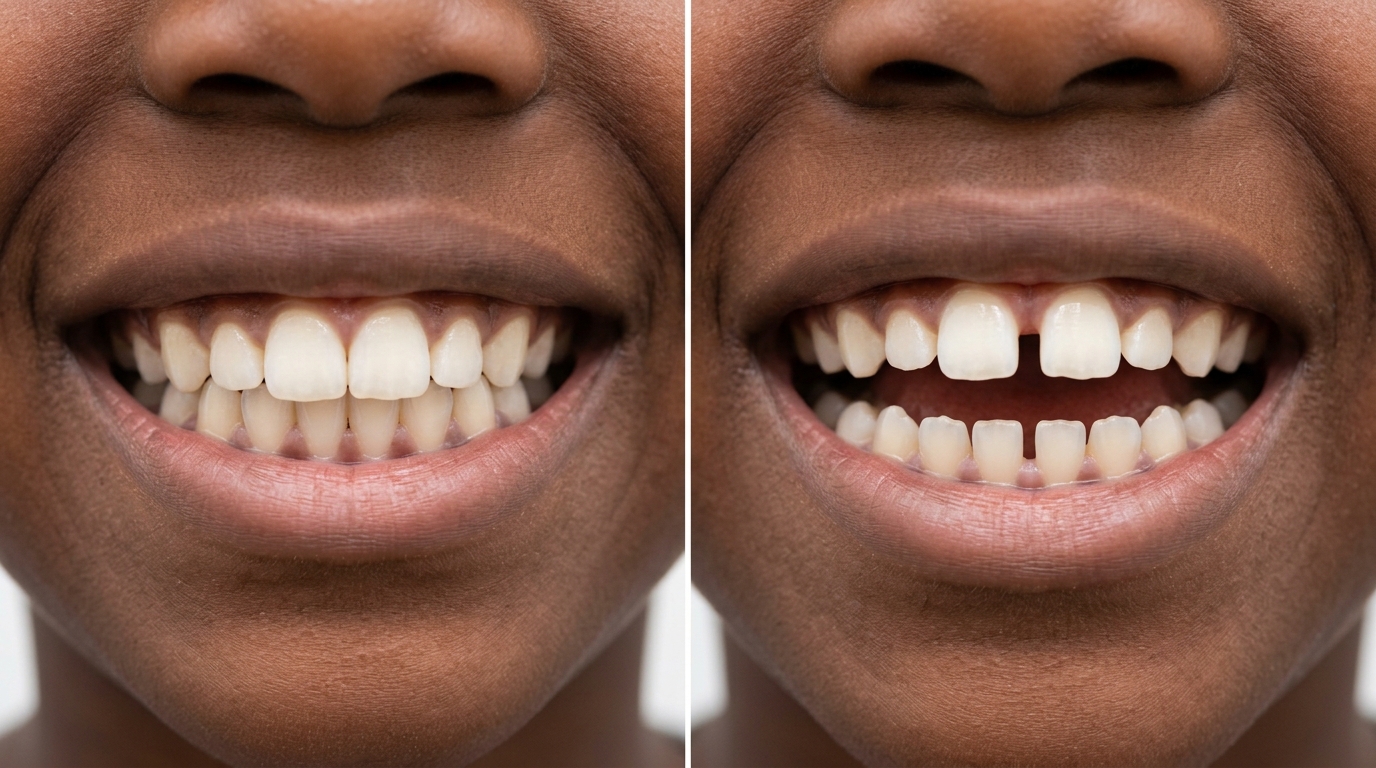
A 2026 meta-analysis of 12 studies found that thumb or finger sucking raised the odds of an open bite about fivefold, while dummy sucking raised them about sevenfold.¹ In other words, both habits carry a real risk for the front teeth.
Crossbite
A crossbite happens when the upper back teeth sit inside the lower back teeth instead of slightly outside them. It usually means the upper jaw has grown narrower than it should. In some children, the jaw shifts to one side each time they bite down.
Here, dummies appear to be the bigger concern. In the same 2026 analysis, dummy use was clearly linked to crossbite, while thumb sucking was not.¹ A long-running Finnish trial backs this up. Among 451 children followed from birth, those who used a dummy for 12 months or more had a crossbite rate of 7% at age seven, compared with 1% for children who stopped before their first birthday.³
Protruding Front Teeth and Crowding
Many parents worry about “buck teeth”, where the upper front teeth tip forward. A thumb pressing on the back of the upper teeth can contribute to this, and it is one of the most common thumb sucking teeth changes dentists see in long-term thumb suckers.
Crowding is another possible effect. In the Finnish trial, children who sucked a thumb or finger for a year or more were more than twice as likely to have crowded teeth at age seven (36% compared with 16%).³
Thumb or Dummy: Which Is Worse for Teeth?
Parents often ask whether they should swap a thumb for a dummy, or the other way round. The research gives a mixed answer.
For open bite, the 2026 meta-analysis found no meaningful difference between the two habits. For crossbite, however, children who used a dummy had about two and a half times higher odds than those who sucked a thumb.¹
On the other hand, there is a practical difference that matters a great deal. A dummy can be taken away; a thumb is always there. As a result, thumb and finger habits tend to last much longer than dummy habits.³ A habit that ends at two years is far less likely to cause lasting problems than one that runs until seven.
What about “orthodontic” dummies with a flatter, wider teat? In the Finnish trial, children who used a specially shaped dummy had fewer crossbites than those using ordinary dummies (4% against 7%), but the difference was not large enough to be statistically reliable.³ So the shape of the dummy seems to matter less than how long your child uses it.
The Case for Dummies in the First Months
None of this means dummies are bad for babies. In early infancy, they can even help.
The American Academy of Pediatrics recommends offering a dummy when a baby is put down for naps and at night, because this is linked to a lower risk of sudden infant death syndrome (SIDS). For breastfed babies, it advises waiting until feeding is going well before introducing one. If the dummy falls out once the baby is asleep, there is no need to put it back, and a baby who refuses it should never be forced.⁶
A few simple safety habits keep dummy use healthy:
- Never tie a dummy around your baby’s neck or to their cot with a cord or ribbon.
- Never dip it in sugar, glucose, juice or honey. Sweet coatings feed the bacteria that cause decay, and honey is not safe for babies under one year. Our guide to tooth decay in children explains how quickly this damage can start.
- Check the teat regularly and replace any dummy that is cracked, sticky or torn.
- Keep it clean, and avoid “cleaning” it in your own mouth, which passes your bacteria to your baby.
If your baby is cutting their first teeth, a dummy may give some comfort, although it is not the only option. Our article on teething in babies covers safe ways to soothe sore gums.
When Should Your Child Stop? An Age Guide
There is no single deadline that suits every child. Still, the research points to a clear pattern: the earlier a habit ends, the smaller the risk to the teeth.
- Birth to 6 months: Sucking is normal and comforting. A dummy at sleep times may lower SIDS risk.⁶
- 6 to 12 months: Start limiting the dummy to naps and bedtime rather than all day.
- Around the first birthday: The Finnish researchers advise stopping the dummy, or cutting it down to a minimum, after a child turns one, to protect against crossbite.³
- By 3 to 4 years: Most experts recommend that all sucking habits have ended by this age.¹ If your child is still sucking a thumb, now is a good time for a dental check.
- 6 years and older: As the permanent front teeth arrive, a continuing habit can affect the adult teeth. You can read more about this stage in our guide to the loose baby tooth years.
6 Gentle Ways to Help Your Child Stop
Children rarely stop a comfort habit because an adult tells them to. They stop when they feel ready, supported and proud of themselves. These steps tend to work best when you choose a calm time, not the week a new sibling arrives or school begins.
1. Notice the Triggers
Watch when the thumb goes in. Is it while watching TV, in the car, when tired or when upset? Once you know the pattern, you can plan for those moments instead of reacting to them.
2. Praise Instead of Scolding
Nagging and shaming usually make the habit stronger, because sucking is how the child copes with stress. Instead, notice and praise the times when your child is not sucking. Positive attention goes a long way.
3. Try a Sticker Chart
Older toddlers and preschoolers love seeing progress. Give a sticker for each day or night without sucking, with a small reward after a few successful days. Keep the goals short and achievable at first.
4. Keep Little Hands Busy
Offer something else to hold during trigger times, such as a soft toy, a stress ball or a favourite blanket. Busy hands are less likely to drift towards the mouth.
5. Use Gentle Night-Time Reminders
Many children suck their thumb only when falling asleep, without realising it. A cotton glove, a sock over the hand or a plaster on the thumb can act as a friendly reminder. Some families use a bitter-tasting nail coating; if you do, ask a pharmacist for a product that is safe for children.
6. Wean the Dummy Step by Step
For dummies, a gradual approach is often easier than a sudden ban. First, keep the dummy for sleep only. Next, remove it at naps. Finally, let your child “give away” their dummy, perhaps to a new baby or in exchange for a small gift. Avoid cutting or piercing the teat, since loose pieces can become a choking risk.
A friendly dental visit can also help. Children often listen to a dentist in a way they do not listen to a parent. If your child has not been to the dentist before, our tips on how to prepare your child for their first dental visit will make the day easier.
Will My Child’s Teeth Correct Themselves?
This is the good news many parents hope for. In many cases, yes.
A 2023 systematic review looked at children aged four and over who stopped a sucking habit. Across the included studies, the open bite closed on its own in 50% to 100% of children once the habit ended, even when they stopped after age four. In contrast, in one study where children kept sucking a finger, only about 9.5% saw their open bite close.⁴ The authors rated the certainty of this evidence as very low, so it should be read as encouraging rather than guaranteed.
The key message is simple: most thumb sucking teeth changes have the best chance to settle once the habit stops. A crossbite, however, especially one that makes the jaw shift sideways, is something a dentist will want to keep an eye on, because the narrow upper jaw does not always widen by itself.
When a Habit Appliance May Help
Sometimes a child genuinely wants to stop but cannot break the habit, often because it happens during sleep. For these older children, usually around six years or more with changes already showing in the bite, a dentist may suggest a habit appliance.
The most common type is a palatal crib, a small wire frame fixed behind the upper front teeth. It does not hurt; it simply stops the thumb from creating the seal needed for sucking, which removes the satisfaction. Removable reminders and wearable alarms also exist.
A 2025 pilot trial compared a fixed palatal crib with a wristwatch alarm that sounded when the thumb went into the mouth. Among 22 children aged six to 14, 54.5% of those with the crib stopped the habit, compared with 27.3% of those using the alarm. The trial was small, though, and the difference was not statistically significant.⁵
An appliance works best as a reminder, never a punishment. The child needs to understand it and, ideally, agree to it. If the bite has already changed, your dentist may also discuss early orthodontic care through our orthodontics team.
Signs It Is Time to Book a Dental Check
You do not need to wait for a problem before seeing a dentist. Still, these signs of thumb sucking teeth changes suggest your child’s habit should be assessed soon:
- The thumb or dummy habit is still going strong after age three or four.
- There is a gap between the upper and lower front teeth when your child bites together.
- The upper front teeth are tipping forward or spreading apart.
- Your child’s jaw slides to one side when they close their mouth.
- They struggle to bite food with their front teeth or have developed a lisp.
- The sucking thumb looks red, wrinkled or calloused.
- The permanent front teeth are coming through while the habit continues.
- Your child wants to stop but cannot manage it alone.
Ideally, your child will already be seeing a dentist regularly from their first birthday. If you are unsure when to start, our guide on when your child should first see a dentist explains the timing.
A Final Word for Parents
Thumb sucking and dummy use are part of growing up, and there is no reason to feel guilty about a habit that comforted your child through their early years. What matters most is gently guiding them to stop at the right time, so the teeth and jaws can develop as they should. Alongside this, good daily habits such as a tooth-friendly diet protect your child’s smile as it grows. If you are worried about thumb sucking teeth problems, would like a friendly check of your child’s bite, or need support in breaking a stubborn habit, the team at DentMind CBD Dental Centre on the third floor of Victor House, Kimathi Street, is happy to help. You can book an appointment online or message us on WhatsApp, and we will make the visit relaxed and positive for your little one.
For readers who want to explore the research, the full open-access 2025 meta-analysis on sucking habits and open bite is freely available.
References
¹ Faryad, A., Muwaquet Rodriguez, S., & Hijazi Alsadi, T. (2026). The role of digit- and pacifier-sucking habits on malocclusion development in children: Anterior open bite and posterior crossbite. A systematic review & meta-analysis. Dentistry Journal, 14(1), 55. https://doi.org/10.3390/dj14010055
² Gao, C., Wang, M., He, H., Lei, H., & Mei, L. (2025). Association between non-nutritive sucking habits and anterior open bite: A systematic review and meta-analysis. BMC Oral Health, 25, 1124. https://doi.org/10.1186/s12903-025-06040-z
³ Arpalahti, I., Hänninen, K., Tolvanen, M., Varrela, J., & Rice, D. P. (2024). The effect of early childhood non-nutritive sucking behavior including pacifiers on malocclusion: A randomized controlled trial. European Journal of Orthodontics, 46(5), cjae024. https://doi.org/10.1093/ejo/cjae024
⁴ Adriano, L. Z., Derech, C. D., Massignan, C., Flores-Mir, C., Porporatti, A. L., Canto, G. L., & Bolan, M. (2023). Anterior open bite self-correction after cessation of non-nutritive sucking habits: A systematic review. European Journal of Orthodontics, 45(3), 235-243. https://doi.org/10.1093/ejo/cjac054
⁵ Eltager, T., El Bardissy, A., & Abdelgawad, F. (2025). Cessation of thumb/finger sucking habit in children using electronic habit reminder versus palatal crib: A randomized clinical pilot study. BMC Oral Health, 25, 27. https://doi.org/10.1186/s12903-024-05310-6
⁶ Moon, R. Y., Carlin, R. F., Hand, I., & Task Force on Sudden Infant Death Syndrome and the Committee on Fetus and Newborn. (2022). Sleep-related infant deaths: Updated 2022 recommendations for reducing infant deaths in the sleep environment. Pediatrics, 150(1), e2022057990. https://doi.org/10.1542/peds.2022-057990