
Wisdom tooth pain in Nairobi is one of the most common reasons young adults end up searching for a dentist late at night. It often starts as a dull ache at the back of the jaw, the kind you hope will settle by morning. Sometimes it does. Other times, the gum becomes swollen, chewing turns painful, and within a day or two you can barely open your mouth.
Most wisdom tooth problems are uncomfortable rather than dangerous. However, a small number can turn into infections that spread beyond the mouth, and those need attention the same day. Knowing the difference helps you decide whether to book a routine visit or get to a dentist straight away.
This guide explains why wisdom teeth cause trouble, how to recognise the warning signs of an emergency, and what you can safely do while you arrange care.
Why Wisdom Teeth Cause So Much Trouble
Wisdom teeth, also called third molars, are the last teeth to come through. They usually appear in the late teens or early twenties, long after the rest of the adult teeth have settled into place.
By then, there is often not enough room at the back of the jaw. As a result, a wisdom tooth may come through only partly, grow in at an angle, or stay trapped under the gum and bone. Dentists call a trapped tooth “impacted”.
A partly erupted tooth is the one most likely to cause sudden pain. The gum over it does not close properly, which leaves a small pocket where food and bacteria collect. That pocket is very hard to clean with a toothbrush, and it is where most wisdom tooth emergencies begin.
What Is Pericoronitis?
Pericoronitis is inflammation and infection of the gum around a partly erupted tooth. In almost every case, the tooth involved is a lower wisdom tooth.
A flap of gum, known as the operculum, sits partly over the tooth. Food and plaque get trapped underneath it, and the upper tooth may bite down on the flap every time you chew. Consequently, the area becomes irritated, swollen and infected.
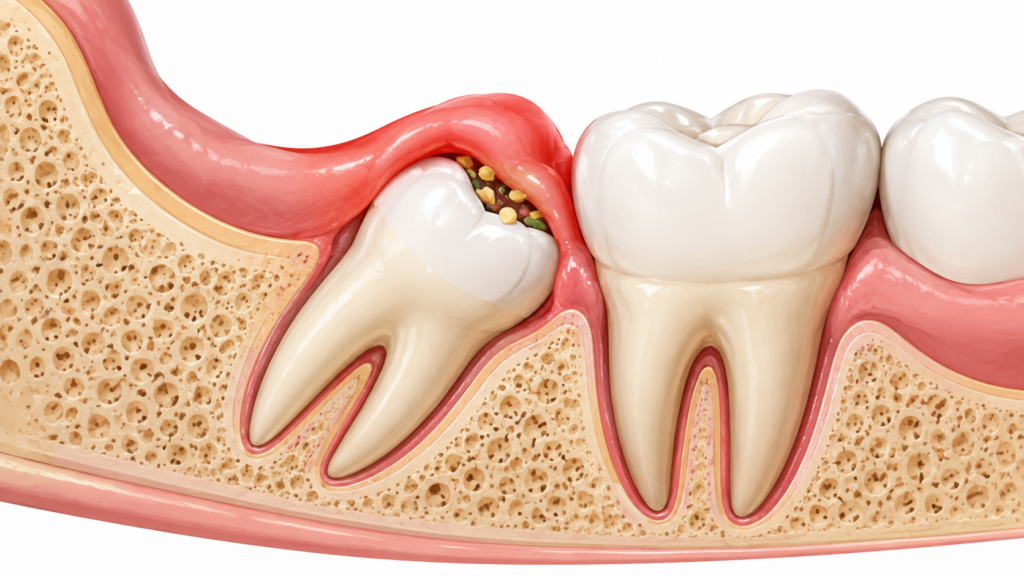
It is a common problem. A 2021 review of pericoronitis management estimated that it affects around 5% of people, most often young adults whose wisdom teeth are still coming through.¹
In its early stage, pericoronitis typically causes pain, swelling of the gum, redness, small ulcers on the gum flap and difficulty chewing.² Many people also notice a bad taste or bad breath that does not go away with brushing.
Normal Discomfort Versus a Real Problem
Not every ache at the back of the mouth means something is wrong. A wisdom tooth pushing through can cause mild, on-and-off tenderness, much like teething. This usually comes and goes over a few days.
In contrast, the following suggest that the gum has become infected and you should see a dentist soon:
- Pain that is getting worse each day rather than settling
- A red, puffy gum flap over the back tooth
- Pain when you bite down or close your teeth
- A bad taste, bad breath or pus coming from the area
- Pain spreading to your ear, throat or the side of your head
These signs are not yet an emergency on their own. Nevertheless, they mean the infection is active, and early treatment is far simpler than treatment once it has spread.
Red Flags: When Wisdom Tooth Pain Becomes an Emergency
The signs below mean the infection may be moving beyond the gum. If you have any of them, you need to be seen the same day.
Swelling That Spreads to Your Cheek, Jaw or Neck
Swelling that stays on the gum is one thing. Swelling you can see from the outside, along the jaw line or under the chin, is different. It means the infection has moved into the soft tissues of the face.
Pay particular attention if the swelling grows over a few hours, feels hard or warm, or starts to push down into the neck.

You Cannot Open Your Mouth Properly
When infection reaches the muscles that close the jaw, they tighten and go into spasm. This is called trismus. You may find you can only open your mouth a finger’s width, or not enough to eat or brush.
Trismus is one of the clearest signs that pericoronitis has progressed beyond a simple gum infection.¹
Difficulty Swallowing or Breathing
This is the most serious warning sign. Infection from lower back teeth can spread into the spaces around the throat and under the tongue.
A review of severe dental infections by oral and maxillofacial surgeons described airway obstruction as the most feared complication of these infections.³ Warning signs include trouble swallowing your own saliva, drooling, a muffled or changed voice, a raised or swollen floor of the mouth, and any difficulty breathing.
If you have difficulty breathing or swallowing, do not wait for a dental appointment. Go to the nearest hospital emergency department immediately.
Fever and Feeling Generally Unwell
A raised temperature, chills, fatigue or simply feeling ill alongside tooth pain suggests the body is fighting an infection that is no longer contained. This changes how the problem is managed, and it is one of the main reasons a dentist will consider antibiotics.⁴ ⁵
Pus or a Foul Taste That Keeps Coming Back
A salty or foul taste, or pus you can see or feel, means there is an active collection of infection under the gum flap. If this keeps returning, the problem will not resolve without treatment.
Why Lower Wisdom Teeth Need Extra Attention
The position of lower wisdom teeth makes their infections more likely to spread. They sit right next to the spaces of the floor of the mouth, the throat and the neck.
According to the same surgical review, lower molars are the most frequent source of severe dental infections. In one study it cites, lower wisdom teeth were responsible for 68% of cases.³
That does not mean every sore wisdom tooth is dangerous. Most are treated easily and heal well. Rather, it is the reason dentists take swelling around a lower wisdom tooth seriously and prefer to see it early.
If your face is already swollen, our guide to dental abscess and facial swelling explains more about how tooth infections spread.
What You Can Do Before You Reach a Dentist
While you arrange an appointment, a few simple steps can ease discomfort and help keep the area clean.
- Rinse gently with warm salt water several times a day, especially after eating, to flush food from under the gum flap.
- Keep brushing. Use a soft brush and clean carefully around the back tooth, even if it is tender. Leaving the area alone allows more plaque to build up.
- Eat soft food and chew on the other side of your mouth.
- Use a cold compress on the outside of your cheek in short spells if it helps with discomfort.
- Drink plenty of water and rest.
There are also things to avoid:
- Do not apply heat to a swollen face.
- Do not place aspirin or any tablet directly on the gum, as this can burn the tissue.
- Do not try to burst or cut the swelling yourself.
- Do not use leftover antibiotics from a previous illness.
These measures can make you more comfortable. However, they do not treat the cause, so you still need to be seen by a dentist.
Painkillers and Antibiotics: What They Can and Cannot Do
Many people try to manage wisdom tooth pain with tablets alone. It is worth understanding what each type of medicine can realistically achieve.
Painkillers
Current evidence-based guidance from the American Dental Association recommends anti-inflammatory painkillers such as ibuprofen, used alone or with paracetamol, as the first choice for acute dental pain. This combination generally gives better relief than opioid painkillers, with fewer side effects.⁴
Always follow the dosing instructions on the packet or from a pharmacist, and check with a professional if you have stomach problems, asthma, kidney problems, are pregnant, or take other medicines. Importantly, painkillers only quiet the symptoms. The infection under the gum will continue until the area is cleaned or the tooth is treated.
Antibiotics
Antibiotics are often seen as the cure for a sore wisdom tooth, but the evidence says otherwise. A systematic review found that antibiotics are frequently prescribed for pericoronitis when they are not needed, and identified this as a significant driver of antibiotic overuse in dentistry.¹
Dental guidelines reserve antibiotics for specific situations, such as swelling that is spreading or signs of a body-wide infection like fever and feeling unwell.⁵ Even then, they work alongside proper dental treatment, not in place of it. For simple, localised pericoronitis, cleaning the area under the gum flap is the key step.¹ ²
This is why a person who only takes antibiotics often finds the pain returns a few weeks later. The tablets settle the flare, but the pocket of trapped food and bacteria is still there.
What Happens at Your Emergency Visit
When you arrive with wisdom tooth pain, the dentist will first check how far the infection has gone. This usually includes:
- Asking about your symptoms, how long you have had them and any medical conditions
- Checking your temperature and looking for swelling of the face and neck
- Measuring how wide you can open your mouth
- Examining the gum flap and the tooth underneath
- Taking an X-ray to see the position of the wisdom tooth and the bone around it
For early pericoronitis, treatment normally involves gently washing out the area under the gum flap, removing trapped food and debris, and controlling the pain. Reviews of the evidence support local irrigation and gentle cleaning as the first step in managing the condition.¹ ²
If the infection has spread, the dentist may drain the swelling and prescribe antibiotics. In rare cases where the airway is at risk, you will be referred urgently to hospital, where early surgical and antibiotic treatment gives the best outcome.³
Will the Wisdom Tooth Need to Come Out?
Not always. A single, mild episode of pericoronitis can settle with cleaning and good home care, particularly if the tooth still has room to come through fully.
However, extraction is often recommended when:
- Pericoronitis keeps coming back
- The tooth is impacted and has no realistic chance of coming through properly
- The upper wisdom tooth keeps biting into the gum flap
- Decay or damage has developed in the wisdom tooth or the tooth next to it
The pocket that causes pericoronitis exists because of the tooth’s position. If that position cannot change, the problem tends to return. Removing the tooth deals with the cause rather than the symptoms.¹
Ideally, any extraction is planned once the acute infection has settled, so the procedure is more comfortable and healing is smoother. You can read more about the procedure on our wisdom tooth extraction page.
Pain After a Wisdom Tooth Extraction
Some discomfort after wisdom tooth removal is normal, and it usually peaks within the first two days. The American Dental Association guidance notes that moderate to severe pain lasting beyond 24 to 48 hours is uncommon after most dental procedures.⁴
Contact your dentist if, a few days after extraction, the pain gets worse instead of better, you develop a bad taste or smell from the socket, or swelling increases again. The guidance specifically advises that severe pain around 72 hours after a procedure should prompt a return to the dentist to check for a complication such as infection or a dry socket.⁴
When Pain Strikes After Hours
Wisdom tooth pain has a habit of flaring at night or over the weekend. If that happens, our article on toothache at night in Nairobi CBD covers practical ways to get through until morning.
Remember the rule of thumb: pain alone can usually wait for the next available appointment, but swelling that is spreading, a jaw that will not open, fever, or any difficulty swallowing or breathing cannot.
Final Word on Wisdom Tooth Emergencies
Wisdom tooth pain is common, and most cases are straightforward to treat when caught early. The danger lies in waiting too long, relying on painkillers or leftover antibiotics, and allowing a small gum infection to spread. Watch for the red flags in this guide, keep the area clean, and do not ignore swelling that is growing. If you are dealing with wisdom tooth pain in Nairobi, the team at DentMind CBD Dental Centre on Kimathi Street offers same-day emergency appointments to assess the tooth, ease the pain and plan the right treatment. You can book online, message us on WhatsApp or call 0715 063640, and you can learn more about our emergency dental care in Nairobi CBD before you visit.
For general background on wisdom teeth and when they are removed, see the NHS guide to wisdom tooth removal.
This article is for general information and DOES NOT REPLACE a professional dental or medical assessment. If you have difficulty breathing or swallowing, go to the nearest hospital emergency department immediately.
References
¹ Schmidt, J., Kunderova, M., Pilbauerova, N., & Kapitan, M. (2021). A review of evidence-based recommendations for pericoronitis management and a systematic review of antibiotic prescribing for pericoronitis among dentists: Inappropriate pericoronitis treatment is a critical factor of antibiotic overuse in dentistry. International Journal of Environmental Research and Public Health, 18(13), 6796. https://doi.org/10.3390/ijerph18136796
² Schalch, T. O., Martimbianco, A. L. C., Gonçalves, M. L. L., Motta, L. J., Santos, E. M., Cecatto, R. B., Bussadori, S. K., & Horliana, A. C. R. T. (2022). Interventions for early-stage pericoronitis: Systematic review of randomized clinical trials. Antibiotics, 11(1), 71. https://doi.org/10.3390/antibiotics11010071
³ Neal, T. W., & Schlieve, T. (2022). Complications of severe odontogenic infections: A review. Biology, 11(12), 1784. https://doi.org/10.3390/biology11121784
⁴ Green, V. G., Polk, D. E., Turturro, M. A., Moore, P. A., & Carrasco-Labra, A. (2025). Evidence-based clinical practice guidelines for the management of acute dental pain. American Journal of Emergency Medicine, 89, 247-253. https://doi.org/10.1016/j.ajem.2024.12.054
⁵ Lockhart, P. B., Tampi, M. P., Abt, E., Aminoshariae, A., Durkin, M. J., Fouad, A. F., Gopal, P., Hatten, B. W., Kennedy, E., Lang, M. S., Patton, L. L., Paumier, T., Suda, K. J., Pilcher, L., Urquhart, O., O’Brien, K. K., & Carrasco-Labra, A. (2019). Evidence-based clinical practice guideline on antibiotic use for the urgent management of pulpal- and periapical-related dental pain and intraoral swelling: A report from the American Dental Association. Journal of the American Dental Association, 150(11), 906-921.e12. https://doi.org/10.1016/j.adaj.2019.08.020